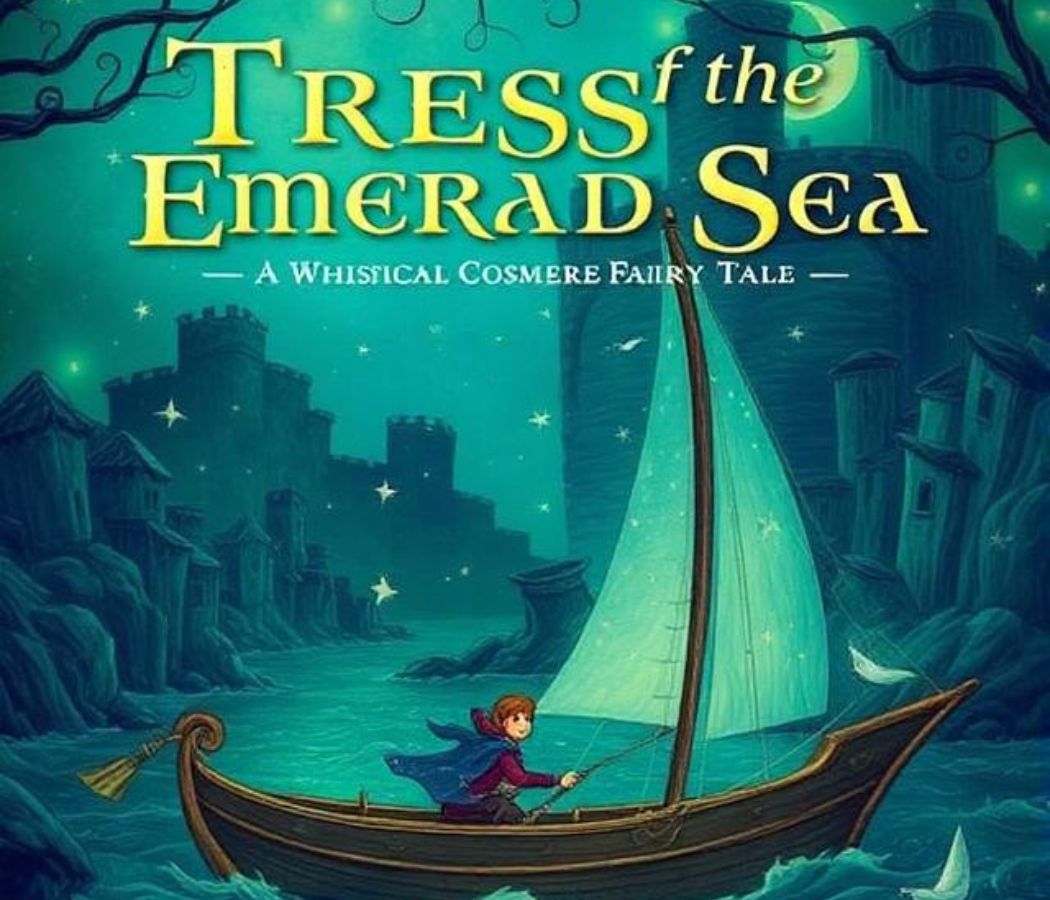
Brandon Sanderson built an empire with doorstopper-sized epics like The Stormlight Archive and gritty heist tales like Mistborn. So, when he announced a “Secret Project”—a standalone, self-contained novel inspired by The Princess Bride—even his most dedicated fans were intrigued.
The result is Tress of the Emerald Sea, a quiet little revolution in fantasy storytelling. The New York Times bestselling author expands his Cosmere universe with a novel that feels both fresh and timeless. But is it just a fluffy fairy tale, or is there more beneath the surface?
Table of Contents
ToggleThe Story: A Princess Bride, Reversed
The story begins on The Rock, a tiny, barren island in the middle of a deadly emerald-green ocean. Here, we meet Tress, a pragmatic and soft-spoken girl who works as a window washer and finds joy in a simple pleasure: collecting teacups brought by traveling sailors. Her only friend is Charlie, the kind son of the local duke who loves telling stories rather than fencing.
Of course, their quiet friendship blossoms into love. The disapproving duke sends Charlie away on a voyage to find a suitable wife—but disaster strikes, and Charlie is captured by the mysterious, all-powerful Sorceress of the Midnight Sea.
In a delightful twist on the classic tale, Tress decides to rescue him herself [5†L44-L45]. This isn’t a journey of a chosen one; it’s the story of a broom-maker’s daughter who decides to cross the most dangerous oceans in existence for the boy she loves. She stows away on a smuggler ship, befriends a talking rat, and ends up joining a crew of reluctant pirates. Her adventure will take her from the Verdant Sea to the Crimson Sea and, finally, the deadly Midnight Sea in hopes of doing the impossible—defeating an unbeatable sorceress.
A World of Deadly Spores
The most striking element of the novel is its worldbuilding. The world of Lumar isn’t like anything Sanderson has created before—in fact, he’s called it the “craziest worldbuilding” of his four secret projects. The oceans aren’t made of water. Instead, they are filled with microscopic spores that rain down from twelve stationary moons.
These spores are extremely reactive to water. The slightest drop can cause them to explosively sprout into fast-growing vines (for the Verdant spores), create deadly substances, or worse. Sailors have to navigate seas of powder on silver-hulled ships, knowing that a splash of water or a single leak in the hull could mean certain death.
The Magic: Sprouting and Science
Magic in Lumar is a fascinating blend of science and intent. The spores aren’t just a passive threat; skilled sailors known as “sprouters” can manipulate them. For example, Tress learns that Verdant spores react to the mental intent of the grower. When exposed to water, a sprouter can guide the resulting vines, allowing for incredible feats of engineering or even creating a massive tree to lift a ship out of danger.
This “soft magic with hard rules” approach is classic Sanderson. The wonder of a sea made of powder is grounded by a consistent logic that allows characters (and readers) to find clever solutions within the world’s limitations.
Key Characters on a Quest
Tress isn’t a warrior, spy, or chosen one. She’s a kind, logical, and deeply practical young woman who is almost debilitatingly polite. Her superpower is not swordplay but determination coupled with a sharp, scientific mind. She talks her way into situations, cleans her way out of others, and solves problems not through violence but through observation and kindness. She embodies the idea that true courage isn’t the absence of fear, but the will to act in spite of it.
The cast she meets along the way is just as colorful:
-
Charlie (Tress’s Beloved): The sweet, story-loving gardener who is secretly hiding a prince’s identity and a curse.
-
Hoid (The Narrator): A mysterious, wise-cracking cabin boy who serves as the story’s narrator, regularly breaking the fourth wall to offer wry commentary.
-
The Crew of the Crow’s Song: A found family of endearing misfits, including:
-
Ann, the gun-loving carpenter.
-
Fort, the loyal quartermaster.
-
Salay, the skilled helmswoman.
-
Dr. Ulaam, a member of the Kandra race with a morbid appetite.
-
-
The Antagonist: The Sorceress, Riina, is a powerful tyrant with mysterious motives who rules the Midnight Sea.
Who Tells the Story? Hoid’s Unique Narrative
One of the most debated choices in the book is its narrator: Hoid. The story isn’t told in a standard third-person perspective; it’s a story being told to you by a character in a tavern. Hoid constantly interrupts the flow to offer philosophical asides, crack jokes about the characters, or directly address the reader.
For many, this is the highlight of the book. His sharp wit and modern commentary—like snarking about a duke whose “great number of his troops had died, while he lived” [10†L26-L28]—adds a layer of satire and charm. For others, this narrative intrusion can be jarring, pulling them out of the immersion of the fantasy world.
Key Themes and Analysis
Beneath its whimsical surface, Tress of the Emerald Sea explores powerful themes that resonate long after the final chapter.
Growth and Identity
The novel argues that identity is fluid. Tress begins as a doormat who is scared to ask for a rise in her allowance; she ends as a decisive captain. Charlie transforms from a passive victim into someone who seizes his own fate. As Hoid explains, “people are as fluid as time is. We adapt to our situation like water in a strangely shaped jug”. This theme of growth through adversity is central to the narrative.
Character-Driven Change Over Pure Escalation
Unlike many fantasy stories where the hero’s journey is a steady escalation of power, Tress’s decisions constantly balance courage with prudence. She doesn’t become a master swordfighter overnight; she becomes more competent, more confident, and more independent through a series of small, logical choices.
Pure, Unpretentious Love
There is something almost radical about how earnest this book is. Tress’s motivation is love—not destined love, not chosen-one love, but the simple, stubborn love for a friend. The novel challenges traditional fairy tale and fantasy tropes, particularly gender roles, by having a gentle, unassuming heroine be the proactive hero of her own story.
The Bond of Found Family
These themes coalesce around the crew of the Crow’s Song. It’s a beautiful exploration of how community isn’t forged by blood or convenience, but by shared experience and mutual support. Tress finds a place among them not because she is powerful, but because she is kind and competent, offering leadership when it is needed.
Critical and Audience Reception
The book has been a massive success with both critics and readers.
The Kirkus review called it “engrossing,” praising its “appealing characters, and a sense of humor” that “make this a winning entry in the Sanderson canon”. The Good Reading Magazine raved that it is a “rollickingly good fun adventure narrative… hard to put down”.
Readers have hailed it as “a cushy, cosy read” that is both “wonderful, delightful” and a “treasure trove in hints and foreshadowing” for long-time Cosmere fans. The most consistent praise goes to the protagonist: “Tress is a refreshing protagonist. Level-headed and open minded, she tackles every challenge with an admirable combination of logic, kindness, and grit”. Critics have found that while some feel the pacing drags in parts, overall it’s “hailed as a must-read for fantasy enthusiasts seeking a richly detailed escapade”.
Who Should Read This Book?
-
If you loved the movie The Princess Bride, you’ll adore this modern fantasy twist on its premise.
-
If you’re new to Sanderson or intimidated by massive series like Stormlight, this is the perfect entry point. It’s a standalone, lighter in tone, and a brilliant showcase of his strengths.
-
If you want to see a different side of Sanderson, this book is a must-read. It proves he’s not just a master of hard magic systems and epic battles, but also of wit, heart, and genuine charm.
-
If you appreciate strong character-driven narratives over pure plot escalation.
-
If you’re a devoted Cosmere fan, you’ll be delighted by the deeper lore connections and worldbuilding hints sprinkled throughout, including the introduction of the elusive aethers.
Final Verdict: A Gem of a Tale
Tress of the Emerald Sea feels like a heartwarming conversation with a clever friend. It is a whimsical adventure with stakes that are both huge and deeply personal. While its narrator and slow pace may not be for everyone, those who roll with the punches will find it a brilliantly original, wonderfully charming, and surprisingly insightful read that lingers long after the last page.
This is a story about finding courage you didn’t know you had, for a person who is worth more than the entire world. And that, in the end, is a timeless magic more powerful than any sorceress’s curse.
I hope you enjoyed this detailed look at Tress of the Emerald Sea. Have you read it? What did you think of Hoid’s narration? Let me know in the comments below!