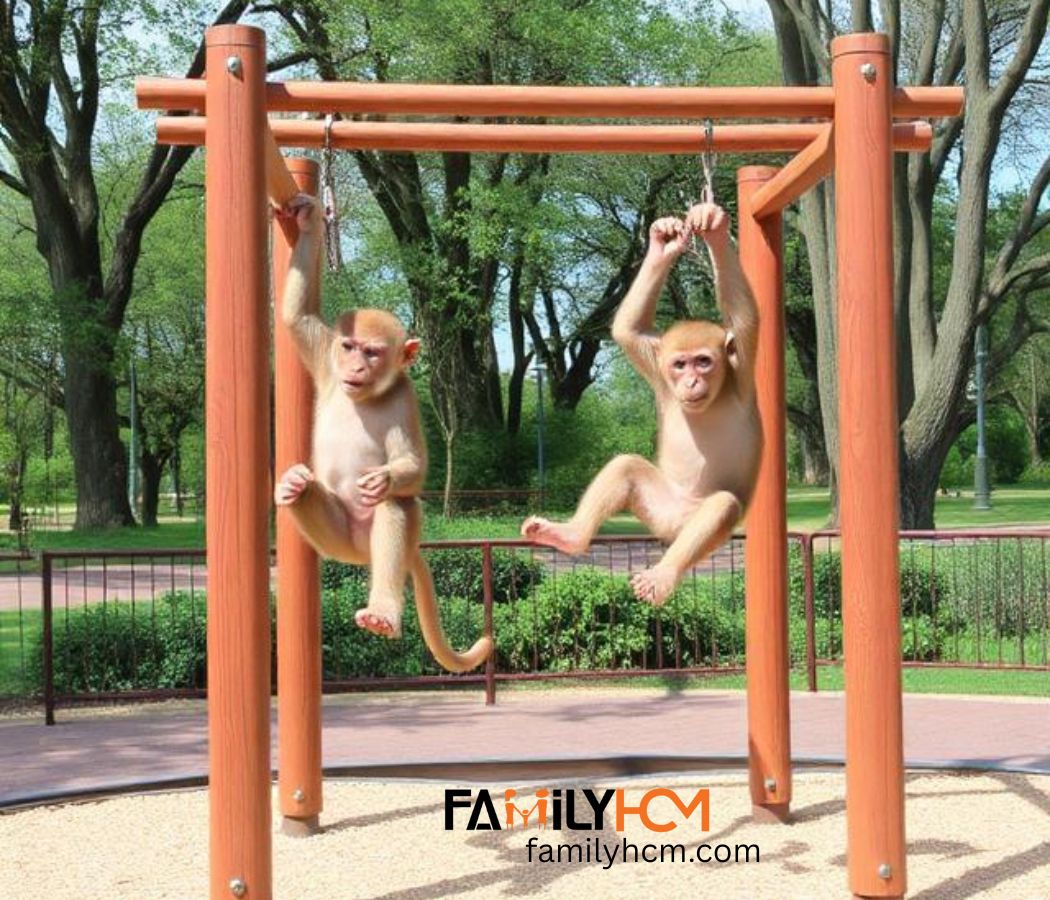
When was the last time you hung from a set of monkey bars? For most adults, the answer is “decades ago.” We tend to think of this playground staple as just a piece of children’s equipment. But the truth is, the humble overhead ladder (commonly known as monkey bars) is one of the most effective full-body fitness tools ever invented.
Whether you are a parent watching your toddler take their first swing or a CrossFit athlete looking to improve grip strength, the monkey bar deserves your respect.
In this post, we are breaking down the history, the surprising health benefits, proper safety protocols, and how to progress from hanging to swinging like a pro.
A Quick History: Why “Monkey” Bars?
Interestingly, the original patent for the jungle gym (the larger structure) was filed in 1920 by Sebastian Hinton. But the specific overhead ladder we call monkey bars got its name because the creator, law professor Frank M. North, watched his child climb across them. He remarked that the child moved “like a little monkey.”
The name stuck for over a century, symbolizing agility, play, and primal movement.
The Physical Benefits (For Kids and Adults)
Most people assume monkey bars are just for fun. In reality, they are a powerhouse for functional fitness.
1. Grip Strength (The Longevity Marker)
Scientists now believe that grip strength is a massive predictor of longevity. As we age, grip strength declines. Hanging from monkey bars actively fights this.
-
For Kids: Builds the foundation for handwriting and fine motor skills.
-
For Adults: Reduces risk of arthritis and improves performance in rock climbing, tennis, and golf.
2. Upper Body & Core Development
You don’t need a pull-up bar if you have monkey bars.
-
Lats and Shoulders: The horizontal swing motion targets the back differently than vertical pull-ups.
-
Core Stability: To swing from rung to rung without dropping, your rectus abdominis and obliques must fire constantly to stop your legs from swaying.
3. Spatial Awareness & Coordination
Navigating a set of bars requires your brain to calculate trajectory, timing, and distance. This is proprioception—the sense of knowing where your body is in space. For developing children, this is critical for preventing injuries in other sports.
The Safety Checklist: Preventing the “Fall”
Let’s be real. Monkey bars have a reputation for causing broken wrists. However, with the right setup and supervision, the risk is minimal.
Before you swing, follow these 3 rules:
-
The Surface Matters: Never install monkey bars over concrete or asphalt. You need impact-absorbing mulch, rubber tiles, or sand to a depth of at least 9 inches.
-
Height Check: For preschoolers, the bars shouldn’t be higher than their reach (usually 4-5 feet). For adults, standard height is 7-8 feet.
-
The “Dead Hang” Rule: Never let two kids swing on the same rung at the same time. The structural wobble can cause a fall.
How to Master the Monkey Bars (Progression Guide)
Are you an adult who can barely hang for 5 seconds? Or a parent whose kid is scared to leave the ladder? Use this progression.
Phase 1: The Dead Hang
Simply grab the bar and let your feet dangle. Aim for 15 seconds. This stretches the spine and decompresses the vertebrae. Do this daily for a week.
Phase 2: The “Monkey Shoulder” (Controlled Shrugs)
While hanging, actively pull your shoulders down away from your ears (a scapular retraction). Do not do pull-ups yet. Just shrug and release. This builds the rotator cuff stability needed to catch your weight.
Phase 3: The One-Arm Release
Hang with both hands. Release one hand and tap your hip. Grab the bar again. Repeat on the other side. This teaches your nervous system to trust one arm.
Phase 4: The Swing
Grab the first rung. Instead of reaching far for the next rung, twist your torso and throw your shoulder toward the target. Momentum, not pure strength, gets you across.
DIY vs. Store Bought: Which Should You Choose?
If you want monkey bars in your backyard, you have two options.
-
Metal Kits (Best for Durability): Look for powder-coated galvanized steel. It won’t rust or splinter. Expect to pay 300−800 for a standalone set.
-
Wooden DIY (Best for Aesthetics): Requires pressure-treated lumber (4×4 posts) and steel piping for the rungs. Warning: Wood expands and contracts. You must drill pilot holes, or the wood will split under your weight.
The Pro Verdict: For adults training calisthenics, buy a wall-mounted pull-up ladder. For kids, a metal A-frame structure is safer than wood.
Monkey Bars for Functional Fitness (The Workout)
Want to get shredded? Try this 15-minute “Park Circuit.”
-
Minute 0-3: Slow dead hangs (30 sec on, 30 sec rest).
-
Minute 3-6: Lateral swings (Go across the bars and back).
-
Minute 6-9: Knee tucks (Hang from the bar, tuck knees to chest).
-
Minute 9-12: Pull-up holds (Hold the top of a pull-up position for 5 secs).
-
Minute 12-15: Passive swings (Swing your legs like a pendulum to cool down).
Final Verdict: Don’t Outgrow the Bars
We live in a seated society. We drive sitting, work sitting, and eat sitting. Monkey bars force us to get vertical.
They decompress the spine after a long day at a desk. They humble the strongest bodybuilder who skips grip work. And for your children, they offer a screen-free challenge that builds real, functional confidence.
So, the next time you pass a playground, don’t just stand there scrolling on your phone. Grab the bar. Hang for ten seconds. Feel the stretch.
Detailed FAQs About Monkey Bars
1. Are monkey bars good for adults, or are they just for kids?
Absolutely good for adults. Monkey bars provide a low-impact, high-reward form of functional training. They improve grip strength (a key longevity marker), decompress the spine after hours of sitting, and build upper back and core muscles. Many calisthenics athletes use monkey bars as the foundation for advanced moves like muscle-ups and front levers. The key is to start slowly—begin with dead hangs and progress to swings over several weeks.
2. What muscles do monkey bars work?
Monkey bars engage a surprising full-body chain:
-
Forearms & Grip muscles: Constant activation to hold your body weight.
-
Latissimus dorsi (lats): The primary pulling muscles that move your arms side to side.
-
Rhomboids & Traps: Stabilize the shoulder blades during each reach.
-
Core (rectus abdominis, obliques, transverse abdominis): Prevents the lower body from swinging uncontrollably.
-
Hip flexors & legs (isometrically): Help control momentum, especially when you swing.
In short, they are a compound upper-body exercise with a significant core requirement.
3. How do you get across monkey bars if you lack upper body strength?
You don’t need raw pull-up strength. Use momentum and technique:
-
Start with a two-hand dead hang and gently swing your legs back and forth like a pendulum.
-
Time your next reach: grab the next rung when your body is at the peak of the forward swing.
-
Keep your arms slightly bent (not locked straight) to absorb the catch.
-
Look at the next rung, not the one you’re holding. Your eyes lead your hands.
Practice on a low set of bars where you can drop safely. Many people fail because they try to “muscle” across instead of using rhythm.
4. What is the safest surface to put under monkey bars?
The safest surfaces are impact-absorbing and at least 9–12 inches deep:
-
Engineered wood fiber (playground mulch): Best for home use; affordable and cushions falls well.
-
Poured-in-place rubber: Ideal for public playgrounds; seamless and accessible for wheelchairs.
-
Rubber tiles: Good for flat areas under a metal bar set.
-
Sand: Works but can compact over time; requires raking.
Avoid: Grass, concrete, asphalt, or dirt. A fall from just 4 feet onto hard ground can cause wrist fractures or concussions.
5. At what age can a child start using monkey bars?
Most children can start attempting monkey bars between 3 and 5 years old, but with important caveats:
-
Age 3–4: Focus on the dead hang (5–10 seconds). Install bars at or just above their head height so they can jump up easily.
-
Age 5–6: Begin practicing the “hand-over-hand” motion on a low horizontal ladder (rungs close together, height under 5 feet).
-
Age 7+: Can generally use standard playground monkey bars (height 6–7 feet) with supervision.
Never force a child. Fear of heights or grip fatigue is normal. Let them build confidence by first swinging with your hands supporting their hips.
6. How high should monkey bars be for home use?
The height depends on the user’s age and purpose:
| User Type | Bar Height (from ground) | Rung Spacing (center to center) |
|---|---|---|
| Toddlers (2–4) | 3 – 4 feet | 10 – 12 inches |
| Kids (5–12) | 5 – 6 feet | 12 – 14 inches |
| Teens & Adults | 7 – 8 feet | 14 – 18 inches |
| Calisthenics (wall-mounted) | 7.5 – 8.5 feet | 15 – 20 inches |
For adults training, you want to hang with feet fully off the ground but not so high that a drop causes injury. If you install above 8 feet, add crash mats underneath.
7. Can monkey bars help with back pain?
Yes, for certain types of back pain. The dead hang position gently stretches the latissimus dorsi and decompresses the lumbar spine by reducing pressure on the intervertebral discs. Many people with mild disc compression or tight spinal erectors find relief after 30-second hangs.
Caution: If you have a herniated disc, rotator cuff injury, or shoulder instability, consult a physical therapist first. Hanging can irritate some conditions. Never swing aggressively if you have acute back pain.
8. How do you install monkey bars without digging holes?
If you can’t dig post holes (e.g., rented home or hard clay soil), use a freestanding A-frame kit or a wall-mounted system:
-
Freestanding metal kits: Steel tubing with a wide base (e.g., 8×8 feet). No digging required, but must be placed on flat, level ground. Some add sandbags for extra stability.
-
Wall-mounted pull-up ladder: Bolts directly into studs of a garage or basement wall. Not portable but extremely sturdy.
-
Above-ground anchor systems: Use heavy-duty concrete blocks (e.g., “deck blocks”) placed on compacted gravel. Less stable than poured concrete; only recommended for low bars (under 5 feet).
For safety, always follow the manufacturer’s weight limits and anchor any freestanding structure to prevent tipping.
9. What is the ideal rung thickness for monkey bars?
Rung thickness affects grip comfort, especially for small hands:
-
Children: Diameter of 1.0 – 1.25 inches (standard metal pipe). Thicker than 1.5 inches becomes hard for small hands to wrap around.
-
Adults: Diameter of 1.25 – 1.5 inches. Power-grip bars (1.5 inches) are excellent for building crush grip strength. Larger than 2 inches (e.g., fat gripz) becomes a specialized grip trainer.
-
Material: Galvanized steel or aluminum is best. Avoid PVC pipe – it flexes and can crack under adult weight.
10. Why do monkey bars feel harder than pull-ups?
Because monkey bars require dynamic stability, not just raw pulling power. A pull-up is a vertical, symmetrical movement. Monkey bars force you to:
-
Support your full body weight on one arm for a split second while reaching.
-
Control lateral (side-to-side) momentum – your core has to counter rotation.
-
Use a different grip width each time you move (wide, medium, narrow in sequence).
Even a person who can do 10 pull-ups may only cross 4 rungs on monkey bars. The skill is as important as strength.
11. How do you clean and maintain outdoor monkey bars?
For metal bars: Wipe down with a mild soap-and-water solution every 2–3 months. Check for rust spots – sand and apply rust-inhibiting spray paint. Lubricate bolt connections with WD-40 if they squeak.
For wooden bars: Sand any splinters immediately. Apply a weather sealant (waterproof polyurethane) once per year. Never use pressure-treated wood for rungs if children will mouth them.
General: Every spring, tighten all bolts, check for wobble, and replace worn plastic end caps (which prevent bar rotation).
12. Can monkey bars be used indoors?
Yes, easily. Three options:
-
Doorway pull-up bar with extended handles: Some models (e.g., Iron Gym) allow a narrow monkey-bar-like traverse. Not a full ladder but good for practice.
-
Ceiling-mounted rung ladder: Bolt steel rungs into ceiling joists in a basement or garage. Ensure joists can support dynamic load (minimum 300 lbs).
-
Freestanding indoor calisthenics station: Commercial units (like Stamina or XMark) include monkey bars, pull-up bars, and dip stations. Takes floor space but very safe.
Ensure at least 2 feet of clearance around all sides, and place crash pads underneath.
13. Do monkey bars build grip strength faster than other exercises?
Yes – faster than wrist curls or farmer’s carries. Monkey bars combine isometric endurance (holding a static hang) with dynamic crushing (closing your fingers around each new rung). This variety recruits more motor units in the forearm flexors. A 2021 study in the Journal of Hand Therapy found that 4 weeks of overhead ladder training increased maximum grip strength by 18%, versus 9% for traditional dumbbell wrist curls.
However, for pure grip hypertrophy, supplement with dead hangs and towel pull-ups.
14. What is the best way to warm up before using monkey bars?
Cold muscles + monkey bars = tendon strain. Do this 5-minute warm-up:
-
Arm circles (30 sec each direction) – loose shoulders.
-
Wrist circumduction (30 sec) – rotate hands in circles.
-
Cat-cow stretch (1 min) – on hands and knees to mobilize spine.
-
Dead hangs from a low bar (3 x 10 sec) – no swinging yet.
-
Scapular shrugs (10 reps) – while hanging, pull shoulders down then release.
If you feel any sharp pain in the elbows or shoulders, stop. That is a sign of insufficient warm-up or pre-existing tendinopathy.
15. Are there any risks for people with arthritis?
Yes, caution is needed. Osteoarthritis in the hands or shoulders may be aggravated by the impact of catching your body weight. However, controlled dead hangs (no swinging, smooth release) can actually improve joint mobility by moving synovial fluid.
For rheumatoid arthritis: Avoid completely during flares. On good days, use padded gloves and only hang for 5–10 seconds at a time. Always get clearance from a rheumatologist.
Better alternative: Use assisted monkey bars – wrap a resistance band around the bar and put one foot in the loop to offload 30–50% of your body weight.