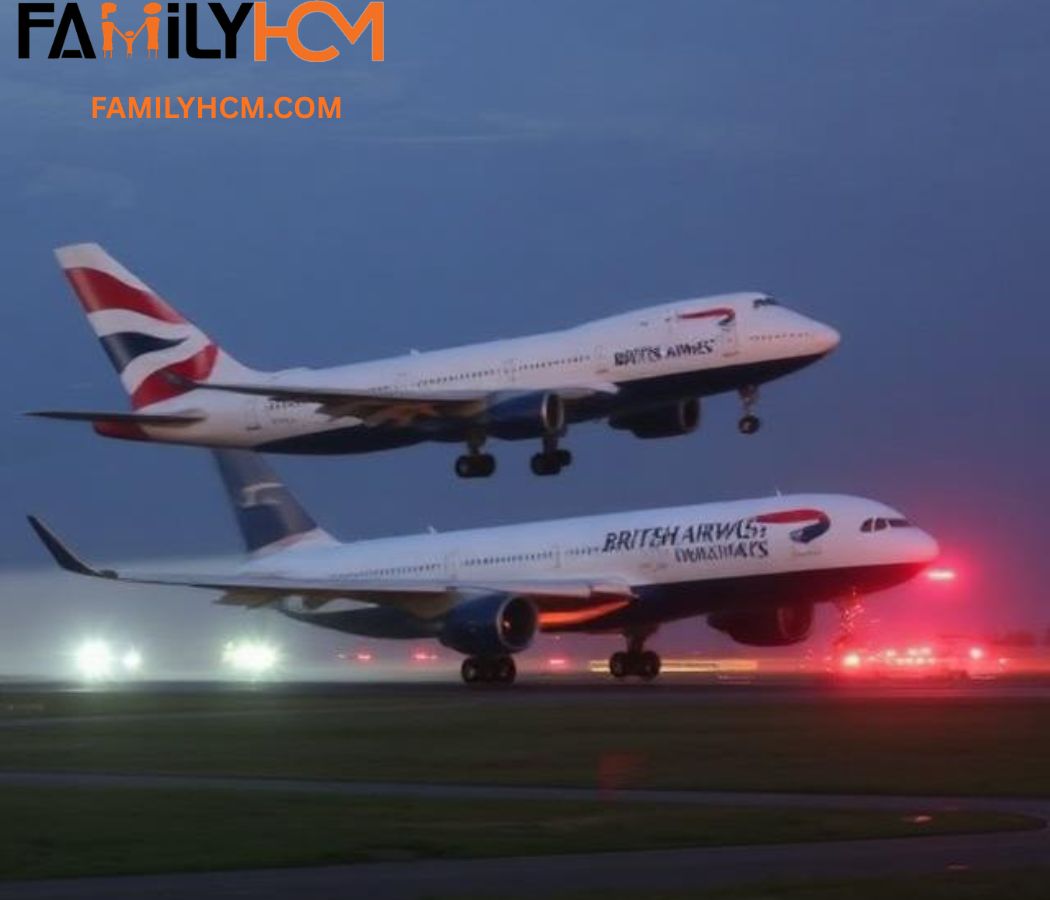
British Airways emergency flight BA286: Imagine settling into your seat on a spacious Airbus A380, ready for a quiet overnight journey from San Francisco to London. Within hours, that peaceful scene abruptly changes as flight attendants begin acting strangely, the crew suddenly becomes incapacitated, and a “toxic fume event” forces an emergency landing hundreds of miles off course.
BA286: Flight Details
The troubled flight was a regularly scheduled British Airways service with the following details:
| Category | Details |
|---|---|
| Flight Number | BA286 |
| Aircraft | Airbus A380-841 (registration G-XLEB) |
| Route | San Francisco International Airport (SFO) to London Heathrow Airport (LHR) |
| Departure Time | Monday, October 24, 2016, 7:13 p.m. PT |
| Scheduled Arrival | Tuesday, October 25, 2016, around 1:40 p.m. GMT |
| On-board | 388 passengers and 25 crew members |
Timeline of Events
October 24, 2016 — En Route to London
The flight departed San Francisco as scheduled, with passengers settling in for the transatlantic journey. About two hours into the flight, as the crew served dinner, the captain made an unexpected announcement: a minor technical issue had occurred, and the aircraft would divert to Calgary.
Passengers on the upper deck soon noticed a “strong noxious smell.”Crew members began exhibiting alarming symptoms: dizziness, lightheadedness, headaches, confusion, forgetfulness, nausea, and a metallic taste in their mouths. Some became aggressive or behaved in a non-normal manner. Flight attendants later described feeling “spaced out,” unable to think straight or even carry on a normal conversation.One report noted that eight of the nine crew members on the upper deck, plus the captain, donned emergency oxygen masks.
“Abnormales Verhalten” — abnormal behavior — was how the lead flight attendant described several crew members in an internal report.
The captain declared a PAN-PAN emergency (the second-highest urgency call, indicating a serious situation that is not immediately life-threatening) and began dumping fuel to reduce the aircraft’s landing weight.
Diversion to Vancouver
At approximately 11:30 p.m. PT (6:30 a.m. GMT), the A380 touched down safely in Vancouver.Emergency vehicles surrounded the aircraft on the tarmac. Firefighters wearing respirators and oxygen masks boarded the plane, a scene that deeply unsettled passengers.
Post-Landing Response
Cause: What Made the Crew Ill?
According to Unite, the pilots informed air traffic control that they were experiencing “toxic fumes, toxic-gas-like fumes.” Despite this, British Airways characterized the incident simply as an “odour event” rather than a serious toxic incident — a classification the union strongly disputed, accusing the airline of “downplaying serious toxic fume events” that could be “an attempt to manipulate official statistics.”
The most likely culprits in such events are chemicals from bleed air systems. In most commercial airliners — including the A380 — cabin air is drawn directly from the engine compressors (so-called “bleed air”). If an engine oil seal fails, microscopic amounts of neurotoxic compounds such as tricresyl phosphate (TCP) can enter the cabin air supply. TCP is a known nerve agent that can cause the exact symptoms reported on BA286: confusion, dizziness, nausea, and cognitive impairment.
British Airways stated that a full engineering inspection in Vancouver, followed by additional tests during the empty ferry flight back to London, found no mechanical fault with the aircraft. The airline maintained that it had shared all investigation details with the UK Civil Aviation Authority.
Passenger and Crew Experiences
Passengers: The ordeal left many passengers in the dark. Several passengers noted that the flight crew cleared away dinner trays without explanation before announcing the diversion. Passenger Steve Lowy told CBC News that he did not notice anything unusual from his seat on the upper deck and said, “We just sat there in silence, being very British.” Other passengers described the atmosphere as tense and confusing, with the crew providing no clear information. One passenger, Liz Keller, tweeted: “Firefighters with respirators walking aisles and only telling us the crew had taken ill does not reassure me”.
Crew: The most detailed account came from the lead flight attendant on BA286, who wrote a report leaked to The Sunday Times. It described 12 crew members whose symptoms gave “cause for concern.” They experienced dizziness, headaches, nausea, itchy red eyes, confusion, and forgetfulness. Most worryingly, “inability to think straight and converse in normal manner” was noted among several crew. A flight attendant interviewed later described some colleagues as “weggetreten” (spaced out or “checked out”).
Even after the crew returned to London, some continued to feel ill. One crew member collapsed upon arrival at Heathrow, and several remained off work for an extended period.
Aftermath
-
No official cause determined: Despite the UK Civil Aviation Authority being involved, the specific origin of the fumes was never identified. British Airways settled on calling it an “odour event” and did not change its reporting protocols.
-
Safety concerns raised: The Unite union called for a UK Public Inquiry into cabin air quality, urging the CAA to release data on the number of fume events so the full scale of the problem could be assessed.
-
Aircraft returned to service: The Airbus A380 (G-XLEB) was thoroughly inspected, no faults were found, and the aircraft was returned to active service. The flight numbers were retired, and BA286 no longer operates.
Why This Matters for Aviation Safety
The BA286 incident is far from isolated. Fume events are a known but controversial safety issue in aviation. While airlines often classify them as low-risk “odour events,” crew unions and safety advocates describe them as serious toxic exposures that can cause both acute and chronic health problems for flight crews and frequent flyers.
Key takeaway: This case highlights the ongoing tension between cost-effective air travel and the safety of bleed-air systems, a technology that has remained largely unchanged for decades. As one aviation commentator noted, the BA286 case has become a benchmark for discussions on long-term exposure risks for flight crew and those who fly frequently.
Official Reactions
-
British Airways statement: “The safety of our customers and crew is always our top priority. We arranged hotel accommodation for customers and rebooked them on alternative flights as soon as possible. Our highly-skilled engineers inspected the aircraft in Vancouver and carried out further tests on its flight back to London. No fault was found.”
-
Unite union statement: “This deeply concerning account raises further serious questions over why the airline sought to downplay the incident as a mere ‘odour event.’ That none of the relevant civil aviation authorities have seen fit to investigate what was clearly a serious toxic fume event is equally astonishing.”
Safety Tips for Concerned Flyers
If you’re a nervous flyer worried about cabin air quality, here are practical steps you can take:
-
Understand the risk: The vast majority of flights are completed without any air-quality incident. Fume events remain statistically rare.
-
Know the symptoms: If you feel sudden dizziness, headache, confusion, nausea, or notice a strange oily or “dirty sock” smell on a flight, report it immediately to the cabin crew.
-
Check airline safety records: Independent aviation safety databases track incidents and can give you an objective view of an airline’s history.
-
Be proactive: If you experience symptoms and they persist after landing, seek medical attention and report the incident to the relevant aviation authority.
-
Advocate for change: The growing public awareness of fume events is slowly pressuring regulators to reconsider bleed-air standards and push for better filtration systems.
Frequently Asked Questions About British Airways emergency flight BA286:
-
Was BA286 a Mayday emergency?
The pilots declared a PAN-PAN — the second highest urgency call, indicating a serious situation that is not immediately life-threatening — not a full MAYDAY (distress). -
Did any passengers die on BA286?
No. There were 0 fatalities and no serious injuries to any passenger. -
What is the difference between a fume event and an odour event?
Airlines often call minor events “odour events.” A fume event typically refers to the presence of potentially toxic chemicals — often from engine oil — in the cabin air. -
Is bleed air safe?
Regulators and most airlines say yes. However, critics point to numerous incidents (including BA286) as evidence that the system needs updating. -
Has BA286 happened again?
There are online reports of a separate medical emergency on BA286 in May 2025, but these are unverified by major news sources and likely conflate the 2016 incident with other events.
Conclusion: British Airways emergency flight BA286
British Airways flight BA286 revealed a deeply unsettling reality: modern aviation’s safety net has a potential blind spot when it comes to the air we breathe inside the cabin. While the emergency landing succeeded and the incident did not seriously harm any passengers, the lingering health effects on crew members and the lack of a definitive cause continue to trouble us deeply.
For passengers, the lesson is not to panic, but to stay aware. For the industry, the lesson is clear: we cannot dismiss fume events as mere “odours.” Until we re‑evaluate bleed‑air systems and implement better monitoring, BA286 serves as a wake‑up call: safety at 35,000 feet depends on more than just working engines — it depends on clean air.