Most of us have a rather messy relationship with sleep. We track our overnight metrics on smartwatches, swallow magnesium supplements before bed, and try our best to read a book instead of endlessly scrolling on our phones. Yet, despite all these internal efforts, we frequently wake up feeling exhausted.
Why does this happen? Usually, it is because we focus entirely on our internal biology while completely ignoring our external physical environment.
You can have the most disciplined pre-bedtime routine in the world, but if your bedroom runs too hot, or streetlights are bleeding through the edges of your blinds, your brain will struggle to drop into the deep, restorative stages of sleep. Optimizing your sleep environment isn’t about buying into wellness fads. It is about actively removing the physical friction that causes nighttime interruptions. Let’s look at the science-backed, practical changes you can make to your bedroom setup to consistently get better rest.
The Hidden Enemy: Micro-Awakenings
Have you ever woken up feeling tired despite technically being in bed for eight straight hours? The culprit is usually micro-awakenings.
These are incredibly brief interruptions in your sleep cycle, typically lasting anywhere from 3 to 15 seconds. Because they are so short, your conscious brain never fully registers them, meaning you won’t remember them the next morning. However, your nervous system registers every single one. If you experience twenty or thirty micro-awakenings a night, your brain is constantly being yanked out of REM (Rapid Eye Movement) and deep slow-wave sleep.
This constant fragmentation prevents your body from completing the essential cellular repair and memory consolidation processes that only occur during deep rest. What triggers these interruptions? Environmental friction. A sudden spike in room temperature, a sliver of ambient light from a passing car, or the physical feeling of rough fabric catching on your skin are all enough to trigger your brain’s alertness systems.
The Temperature Factor: Why Your Bedding Matters
Sleep experts constantly repeat that your bedroom should be cool—usually somewhere between 60 and 67 degrees Fahrenheit (15 to 19 degrees Celsius). The reason for this rule is entirely physiological.
To successfully initiate sleep, your core body temperature needs to drop by about one to two degrees. If your environment is too warm, your body has to work much harder to shed that excess heat. This keeps your heart rate elevated and significantly delays the onset of sleep. But setting your wall thermostat is only half the battle. The micro-climate trapped under your blankets is what actually dictates your physical comfort.
Most households default to using standard cotton linens. While cotton is durable, accessible, and familiar, it has a significant flaw when it comes to overnight temperature management: it absorbs moisture but does not wick it away efficiently. If you naturally sweat during the night, cotton holds onto that dampness. This leaves you feeling clammy and usually causes you to wake up just enough to kick the covers off, only to wake up freezing an hour later.
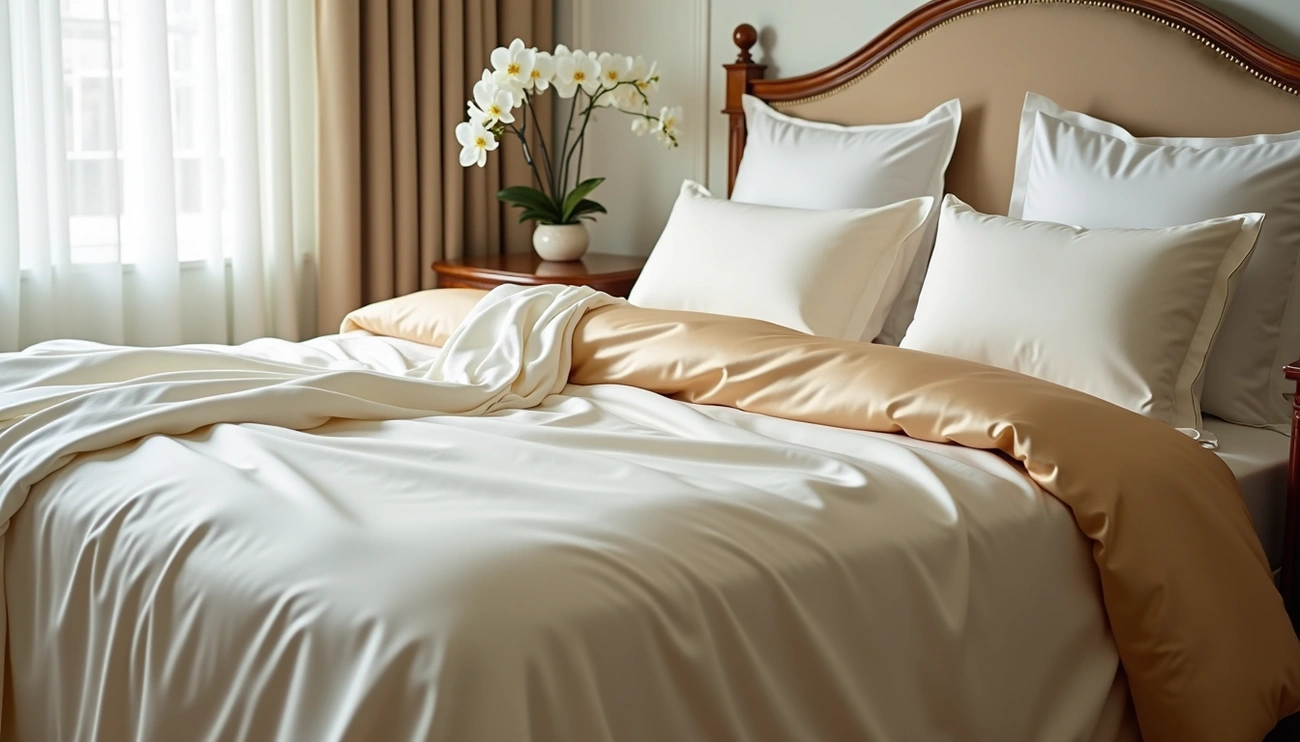
This is where upgrading your textiles makes a tangible, immediate difference. Swapping out standard cotton for high-quality silk bed sheets fundamentally changes how your bed handles body heat. Silk is a natural protein fiber that is highly breathable and inherently temperature-regulating. It allows your excess body heat to escape seamlessly while you sleep, preventing the sauna effect that happens under heavy duvets. Because it doesn’t trap moisture the way cotton does, you stay dry and your core temperature remains highly stable, drastically reducing the number of times you toss and turn.
Comparing Common Bedding Materials
To put this into perspective, here is a breakdown of how common bedding materials impact your overnight sleep micro-climate:
| Material | Temperature Regulation | Moisture Wicking | Tactile Friction | Best Used For |
| Cotton | Moderate | Poor (absorbs and holds sweat) | Medium | General use, budget-friendly guest rooms |
| Linen | Good | Moderate | High (can feel scratchy) | Hot climates, relaxed interior aesthetics |
| Silk | Excellent | Excellent (wicks and evaporates) | Very Low | Hot sleepers, sensitive skin, anti-aging |
| Polyester | Poor (traps heat) | Poor | Medium | Decorative top-bedding, extreme budget |
Total Light Elimination: Protecting Your Melatonin
Light is the single most powerful trigger for your body’s circadian rhythm. It is the primary signal that tells your brain when to be alert and when to power down.
When your eyes detect darkness, your pineal gland starts producing melatonin, the hormone responsible for making you feel sleepy. The modern problem is that our bedrooms are rarely pitch black. We have to contend with neighborhood streetlights, early morning sunlight, the glowing standby lights on televisions, and the bright LED indicators on our phone chargers.
Even if your eyes are closed, your eyelids are thin enough that the photosensitive cells in your retinas can still easily detect ambient light in the room. This light exposure actively suppresses your melatonin production. It keeps you lingering in the lighter stages of sleep and makes you highly susceptible to waking up from minor background noises.
Many people try to solve this issue by installing heavy blackout curtains. While helpful, curtains almost always leave annoying gaps at the top, bottom, or sides where light bleeds in—especially during the early hours of the morning during the summer months.
The most effective, foolproof way to block out light is wearing a dedicated mask. However, the material resting against your face is crucial. Cheap synthetic masks can irritate the delicate skin around your eyes, cause you to sweat profusely, or fit so tightly that they put uncomfortable physical pressure on your eyelids, which ironically makes it much harder to relax.
Instead, using a soft, highly breathable silk eye mask guarantees total darkness without any of the physical discomfort. Because silk is naturally hypoallergenic and causes almost zero friction, it rests gently against your face without absorbing your expensive evening skincare products or causing acne breakouts. By physically blocking all ambient light, you trick your brain into maintaining high melatonin levels until your morning alarm actually goes off, resulting in much longer stretches of uninterrupted deep sleep.
A Practical Action Plan for Tonight
If you are tired of waking up exhausted, stop focusing solely on your sleep tracking apps and start physically modifying your room. Here is a practical, step-by-step checklist you can implement this week:
- Audit Your Light Sources: Turn off all the lights in your bedroom tonight and let your eyes adjust to the dark for two minutes. Look for glowing standby lights on smoke detectors, air purifiers, or electronics. Cover them with a tiny piece of black electrical tape.
- Upgrade Your Micro-Climate: Move away from heat-trapping synthetics and heavy, damp cottons. Invest in breathable, natural fibers for your sheets and pillowcases that actively manage your body heat and reduce physical friction.
- Control the Morning Sun: Keep a high-quality sleep mask right on your nightstand. If you naturally wake up at 5:00 AM because the sun is rising through the blinds, simply slip the mask on to easily grab an extra hour or two of deep sleep.
- Establish a Temperature Baseline: Set your bedroom thermostat to 65 degrees Fahrenheit about an hour before you plan to get into bed. This helps kickstart your body’s natural cooling process before you even pull back the covers.
Good sleep isn’t an occasional luxury; it is a fundamental biological requirement for your immune system, daily cognitive function, and emotional regulation. By taking a hard look at your physical environment—specifically how you manage room temperature, ambient light, and tactile comfort—you can eliminate the hidden barriers that are quietly ruining your rest. Make the physical adjustments to your bedroom, and your biology will naturally follow suit.