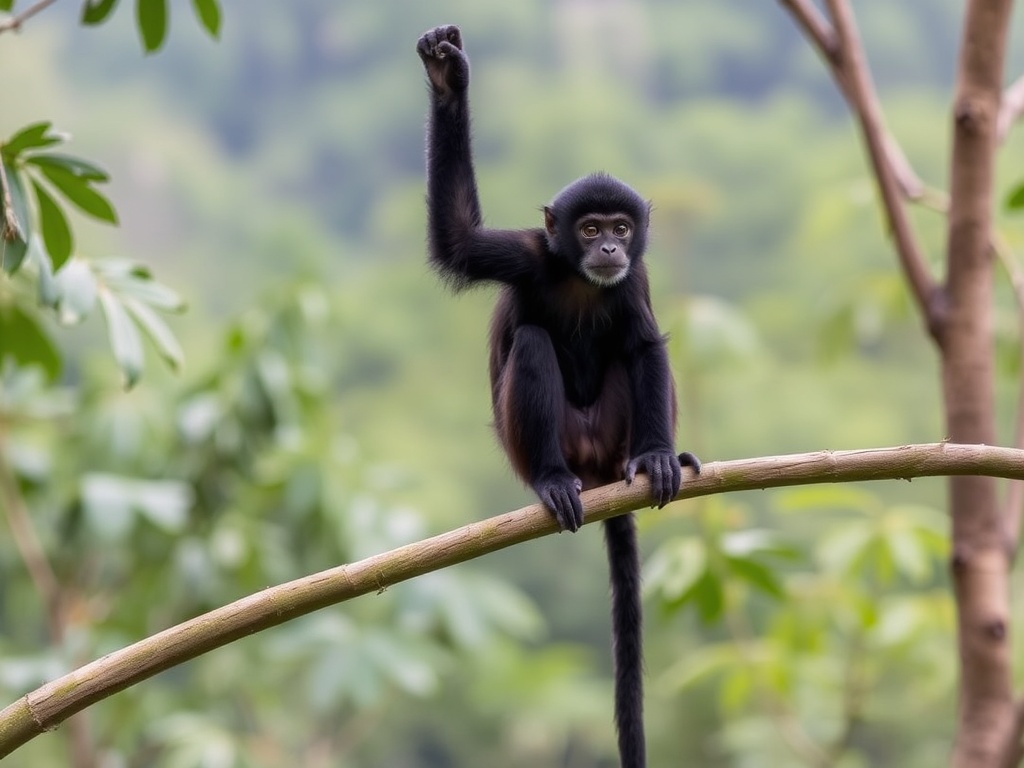
High in the rainforest treetops, a creature with impossibly long limbs and a tail that works like a fifth hand swings effortlessly through the jungle. With their lanky appearance and incredible agility, spider monkeys are one of the most fascinating primates in the Americas. Named because they look like large spiders when hanging by their tails from a branch , these intelligent animals are masters of the arboreal life. However, despite their agility and adaptability, spider monkeys are facing a silent crisis. All seven species are under threat, with their populations declining due to human activity .
In this post, we’ll explore the unique world of the spider monkey, from their specialized anatomy and complex social lives to the critical conservation efforts needed to save them.
Table of Contents
ToggleWhat is a Spider Monkey? Taxonomy and Species
Spider monkeys are New World monkeys, belonging to the genus Ateles . The name Ateles comes from the Greek word atéleia, meaning “incomplete” or “imperfect,” a reference to their most notable physical feature—their reduced or absent thumbs .
There are seven recognized species of spider monkeys, each with distinct ranges and appearances . These include:
-
Red-faced spider monkey (Ateles paniscus)
-
White-fronted spider monkey (Ateles belzebuth)
-
Brown spider monkey (Ateles hybridus)
-
Black-headed spider monkey (Ateles fusciceps)
-
Geoffroy’s spider monkey (Ateles geoffroyi)
They are found in tropical forests from southern Mexico through Central America and into South America, as far south as Bolivia and Brazil .
Anatomy of an Acrobat: Adapted for the Canopy
Spider monkeys are perfectly designed for life in the high canopy, 25 to 30 meters (82–98 ft) above the forest floor . Their body is a toolkit for swinging and hanging.
The Prehensile Tail: A Fifth Limb
The most remarkable adaptation of the spider monkey is its prehensile tail. This muscular tail is longer than their body—up to 89 cm (35 inches) long—and acts as a powerful fifth limb . It can support the monkey’s entire body weight, allowing them to hang from branches and free up their hands to forage for food .
-
Unique Grip: The underside of the tail’s tip is hairless and has flexible, textured skin with grooves that are as unique as a human fingerprint, providing an exceptional grip .
Limbs and Locomotion
Their common name comes from their disproportionately long, spindly limbs, which resemble spider legs as they dangle and move through the trees .
-
Hook-like Hands: Spider monkeys have long, narrow, hook-like hands with four elongated fingers and, most notably, reduced or absent thumbs . This adaptation makes it easier to grip branches and swing, a form of movement called brachiation .
-
No Thumbs: The lack of opposable thumbs actually streamlines their hands for swinging, preventing them from snagging on branches as they fly through the air .
Life in the Troop: Behavior and Social Structure
Spider monkeys are highly social and intelligent animals. They live in groups called troops, which can range from 15 to as many as 40 individuals . However, their social life is dynamic and complex.
Fission-Fusion Society
Spider monkeys have a unique social structure known as fission-fusion, a trait they share with chimpanzees and humans . This means that the large troop doesn’t stay together all the time. During the day, they break off into smaller subgroups of 2 to 8 individuals to forage for food . These subgroups are flexible, changing in size and composition depending on food availability and the risk of predators .
Social Bonds
-
Male Bonds: Unlike many other primate species where females stay with their birth group, female spider monkeys are the ones that disperse at puberty. This means that males in a group are often related and form strong, lifelong bonds. They spend time together, patrol their territory, and will even engage in “grappling,” which involves hugging, tail intertwining, and genital manipulation to reinforce their social ties .
-
Female Leadership: Groups are often directed by a lead female, who is responsible for planning the day’s feeding route, relying on her memory of where fruit trees are located .
Communication
Spider monkeys are vocal creatures. They communicate with a wide range of sounds, including a dog-like “bark” to warn of threats, a whinny similar to a horse, and prolonged screams . If a threat persists, they have been observed shaking branches, and even dropping limbs or defecating on the intruder from above .
The Brainy Frugivore: Diet and Intelligence
Spider monkeys are primarily frugivores, meaning their diet consists mostly of fruit—making up 71 to 83 percent of their food intake . They play a crucial role in their ecosystem as seed dispersers. By swallowing fruit whole and traveling long distances before excreting the seeds, they help regenerate the forest . They supplement their diet with leaves, flowers, nuts, insects, and occasionally bird eggs or bark when fruit is scarce .
This fruit-based diet requires a good memory. To find ripe fruit across a large home range, spider monkeys need to remember the locations of hundreds of trees and know when they are likely to be bearing fruit.
-
High Intelligence: This cognitive demand is likely why spider monkeys have the largest brains of the New World monkeys relative to their body size—twice the size of a howler monkey’s brain . Recent studies have identified them as the most intelligent New World monkeys .
The Circle of Life: Reproduction and Lifespan
Spider monkey reproduction is a slow process, which makes their populations especially vulnerable to decline.
-
Reproduction: Females typically give birth to just one offspring every three to four years . The gestation period lasts around 7 to 7.5 months .
-
Parental Care: Infants are completely dependent on their mothers. They cling to her belly for the first month and continue to ride on her back for up to ten months. They are not weaned until about two years of age .
-
Lifespan: In the wild, they live around 22 years, but they can live much longer in captivity. One famous spider monkey named Gummy lived to be 61 years old .
Conservation Status: A Race Against Extinction
The most urgent topic surrounding spider monkeys today is their conservation. The International Union for Conservation of Nature (IUCN) reports that the population trend for all spider monkey species is decreasing .
-
Critically Endangered: The brown spider monkey (Ateles hybridus) is listed as Critically Endangered, placing it just two steps away from extinction . The black-headed spider monkey is also critically endangered .
-
Threats: The primary dangers are human-driven:
-
Habitat Loss: Vast areas of rainforest are being cleared for cattle ranching, agriculture, and logging, fragmenting their habitat and reducing their food sources .
-
Hunting: Due to their large size, they are a preferred target for hunters for bushmeat .
-
Illegal Pet Trade: Infants are often captured and sold as exotic pets, a process that usually involves killing the mother. Wildlife trafficking remains a significant threat, as seen in cases like the four Mexican spider monkeys recently rescued and placed in the St. Louis Zoo .
-
Conclusion
The spider monkey is an icon of the rainforest—a symbol of the wild, intelligent, and interconnected life that thrives in the canopy. From its finger-less tail and thumb-less hands to its complex society led by experienced females, Ateles is a masterpiece of evolution. Yet, this masterpiece is fading. Their slow reproductive rate makes it difficult for populations to recover from the losses inflicted by deforestation and poaching.
Protecting the remaining tracts of primary rainforest is not just about saving trees; it is about saving the web of life they support. By supporting conservation organizations and sustainable practices, we can help ensure that these “imperfect” primates continue to weave their way through the American tropics for generations to come.
Frequently Asked Questions About Spider Monkeys
1. Why are they called spider monkeys?
Their name is a direct description of their appearance. When they hang from their prehensile tails by a branch, with their long, spindly arms and legs dangling, they resemble a large spider . Their incredibly long limbs and tail create a silhouette that looks just like a spider’s legs from a distance .
2. How do spider monkeys use their tails?
A spider monkey’s tail is a highly specialized tool called a prehensile tail, which means it is adapted for grasping . It acts as a powerful fifth limb, allowing them to hang effortlessly from branches, which frees up their hands to forage for food . The tip of the tail has a hairless, flexible pad with skin grooves that are as unique as a human fingerprint, providing an incredible grip .
3. Do spider monkeys have opposable thumbs?
Interestingly, spider monkeys have very reduced or completely absent thumbs . This adaptation might seem like a disadvantage, but it actually helps them swing through the trees more efficiently. Their hands are long, narrow, and hook-like, allowing them to easily grasp branches and let go without their thumbs getting in the way as they brachiate (swing) from branch to branch .
4. What do spider monkeys eat?
Spider monkeys are primarily frugivores, meaning their diet consists mainly of ripe fruit—making up about 80-90% of their food intake . They play a vital role in the ecosystem as seed dispersers; by swallowing fruit whole and traveling long distances, they excrete the seeds in new areas, helping the forest regenerate . To supplement their diet, they also eat leaves, flowers, nuts, seeds, insects, and occasionally eggs .
5. How smart are spider monkeys?
Spider monkeys are considered among the most intelligent New World monkeys . They have the largest brains of the New World monkeys relative to their body size—twice the size of a howler monkey’s brain . This high intelligence is thought to be linked to their complex social structure and their frugivorous diet. Which requires them to remember the locations of hundreds of fruit trees and know when they will be ripe .
6. What is a “fission-fusion” society?
This term describes the unique and dynamic social structure of spider monkeys, which they share with chimpanzees and humans . Spider monkeys live in large communities called troops (of 20-40 individuals), but they don’t stay together as one cohesive unit . During the day, the troop “fissions” (splits) into smaller subgroups of 2-8 individuals to forage for food more efficiently . Later, these subgroups may “fuse” (reunite) to rest or socialize .
7. How often do spider monkeys have babies?
Spider monkeys have a very slow reproductive rate. Females typically give birth to just one offspring every two to four years . The gestation period is about 7 to 7.5 months (226-232 days) . This slow reproduction makes it difficult for their populations to recover from threats like hunting or habitat loss.
8. How long do spider monkeys live?
In the wild, their average lifespan is around 22 years . However, in human care, such as in zoos, they can live significantly longer, often reaching 30 to 40 years of age .
9. Are spider monkeys endangered?
Yes, spider monkeys are under serious threat. The population trend for all seven species is decreasing . Their conservation status varies by species, but they range from Vulnerable to Critically Endangered . The brown spider monkey, for example, is listed as Critically Endangered, having lost an estimated 85% of its habitat . The main threats are habitat loss from agriculture and logging, hunting for bushmeat, and the illegal pet trade .
10. What is being done to protect them?
Conservation efforts are multi-faceted. A key strategy is creating and protecting wildlife corridors—strips of forest that connect isolated patches of habitat . This allows different groups of spider monkeys to find each other, which increases genetic diversity and reduces inbreeding. Organizations also work with local communities on education, sustainable land management, and establishing private nature reserves . Protecting them in their natural habitat is considered the most critical form of conservation .