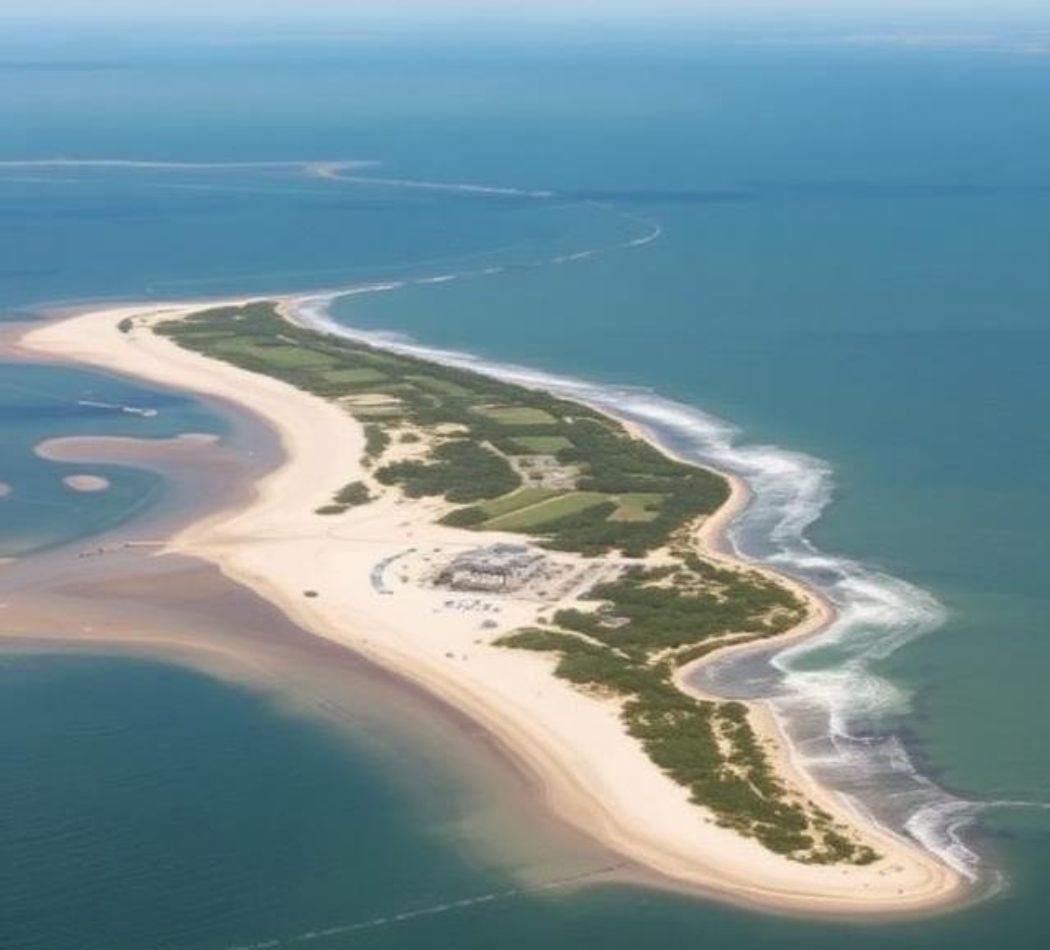
Plum Island Southold NY 11957: Have you ever gazed out from the tip of Long Island’s North Fork, looking across the waters of the Long Island Sound, and wondered about the silhouette of land just visible on the horizon?
That landmass is Plum Island, a name that sparks curiosity, conjures images of mystery, and fuels endless speculation. For over 70 years, this 840-acre island has been a place of secrets, hidden behind a veil of government restrictions and high-security fencing. Accessible only by boat and strictly off-limits to the public, it has been the subject of countless conspiracy theories and the inspiration for best-selling novels.
But what is the real story of Plum Island? Far from hosting sinister experiments, the island houses the Plum Island Animal Disease Center (PIADC)—a state-of-the-art research facility that protects America’s agriculture and food supply. It’s a place of cutting-edge science, global significance, and incredible ecological value. As the lab prepares to close its doors, the island stands at a crossroads, with its future—and its legacy—open to debate.
This article will delve deep into the multi-layered history of Plum Island, NY 11957. We will separate fact from fiction, explore the vital science conducted there, and reveal the surprising natural treasure that we have quietly preserved for decades
Table of Contents
ToggleThe Lore of Plum Island, NY 11957: A Timeline of Mystery
To understand Plum Island, we must first understand its history—a timeline rich with military strategy, scientific ambition, and a heavy dose of secrecy.
From Fort Terry to the Feds (1900s-1954)
The federal presence on Plum Island began long before the lab was ever conceived. At the turn of the 20th century, the U.S. Army established Fort Terry on the island as part of a coastal defense network to protect against naval invasion. The fort’s role evolved over time, serving as a submarine base during World War II. After the war, the fort was deactivated, but its isolation made it the perfect location for a new, highly secretive mission.
The Cold War and Bio-Weapon Research (1952-1954)
During the Cold War, the Army Chemical Corps repurposed Fort Terry for a clandestine program. Research was conducted on “exotic animal diseases both for offensive and defensive purposes” . This brief but significant chapter involved a former torpedo storehouse, now known as Building 257 (or “Lab 257”), where the foundation for the island’s future scientific endeavors was laid. While the offensive biological weapons program was short-lived, it sowed the seeds of secrecy that would define Plum Island for decades.
The Birth of the Animal Disease Center (1954-2003)
In 1954, the mission of Plum Island shifted. The U.S. Department of Agriculture (USDA) took over the facility, and the Plum Island Animal Disease Center was born. The lab was established by an act of Congress to research and protect the U.S. livestock industry from highly contagious foreign animal diseases like foot-and-mouth disease (FMD) . A new, modern laboratory, Building 101, was completed in 1956, solidifying the island’s new purpose.
The Department of Homeland Security Era (2003-2026)
In the wake of the September 11 attacks, the facility’s mission took on a new dimension. In 2003, the newly formed Department of Homeland Security (DHS) assumed management of the lab, partnering with the USDA. The focus expanded to include biodefense and countermeasures against the “accidental or intentional introduction” of a devastating animal disease into the U.S. mainland.
A 2008 directive from Congress ordered the sale of the center and the relocation of its operations to the National Bio and Agro-Defense Facility (NBAF) in Manhattan, Kansas. However, these plans have been met with significant opposition.
The Island’s Vital Mission: Protecting the Nation’s Food Supply
At its core, the Plum Island Animal Disease Center has always been a place of critical scientific research. Its primary purpose is to protect the nation’s food supply, agricultural economy, and food security from transboundary animal diseases.
What is a “Transboundary” Disease?
The diseases studied at Plum Island are not transmissible to humans; they are highly contagious diseases that affect livestock and other animals. Because of the severe economic and food security threats they pose, these diseases are taken incredibly seriously. An outbreak of a disease like foot-and-mouth disease on U.S. soil could cost the economy anywhere from $2 billion to $200 billion.
Key Research Milestones
For over 70 years, PIADC scientists have been at the forefront of veterinary research. Their work has led to significant scientific breakthroughs, including:
-
Developing Vaccines: Scientists developed the first two commercially available vaccines to protect against African swine fever (ASF) in collaboration with researchers in Vietnam.
-
Training First Responders: The USDA Animal and Plant Health Inspection Service (APHIS) has run the Foreign Animal Disease Diagnostician (FADD) course at the lab since 1971. This program has trained thousands of federal and state veterinarians to be first responders, capable of identifying these dangerous diseases in the field.
-
Fighting Rinderpest: Research conducted at PIADC contributed to the global eradication of Rinderpest, or cattle plague—one of only two diseases (alongside smallpox) ever eradicated by humankind.
Splitting Fact from Fiction: Debunking the Conspiracy Theories
The isolation and high-security nature of Plum Island have made it a breeding ground for conspiracy theories for decades. It’s time to separate fact from fiction.
The Lyme Disease Myth
One of the most persistent and powerful myths is that Lyme disease originated from a biological weapons experiment gone wrong on Plum Island . This theory has been promoted by figures like Robert F. Kennedy Jr., but it has been repeatedly and thoroughly debunked by officials and scientists.
Here are the facts:
-
PIADC scientists did not research Lyme disease.
-
The lab’s focus has always been on transboundary animal diseases like FMD and ASF, which do not affect humans.
-
The genetic makeup of the Lyme disease bacterium has been studied by independent scientists, and its evolution does not align with the theory of a lab-engineered pathogen.
-
The American Lyme Disease Foundation itself has stated that there is no evidence to support the theory.
“Silence of the Lambs” and Pop Culture
If you’ve seen The Silence of the Lambs, you might remember the chilling line about Hannibal Lecter having a “wonderful old friend” in the “animal testing division” at Plum Island. This fictional reference has cemented the island’s eerie reputation in pop culture, often causing it to be confused with a mental institution.
Why the Secrecy Feeds the Rumors
Louise Harrison, a senior science advisor for the advocacy group Save the Sound, notes that secrecy is a key driver of these theories. “When places are off limits to the general public, people get alarmed and want to know why and ‘What is going on there?’ They become suspicious and without information they come up with their own theories,” she explained. The government’s decision to end public tours in 2018 only fueled more suspicion.
Plum Island’s Unexpected Future: From Lab to Sanctuary?
As the scientific mission is expected to be fully transferred to the new NBAF facility in Kansas by the end of 2026, the future of the island itself has become a topic of intense debate and interest.
A Hidden Ecological Gem
Ironically, the 70 years of restricted access have been a blessing in disguise for the island’s ecosystems. While humans were kept out, nature flourished. Plum Island is now considered an “ecological gem” and a “natural treasure” .
This unique environment boasts:
-
Over 229 bird species, including the endangered roseate tern and piping plover.
-
New York State’s largest seal haul-out, where hundreds of gray and harbor seals rest on the shores.
-
A diverse array of rare plants and habitats, including maritime forests, salt marshes, and sandy beaches.
The Battle for Preservation
For years, conservation groups and lawmakers have been fighting to preserve the island’s natural and historical resources. The Preserve Plum Island Coalition, which has grown to include more than 100 organizations, is advocating for the island’s future.
Key Points in the Debate:
-
The Plan: The federal government originally planned to sell the island to the highest bidder. However, in 2020, Congress blocked the public sale, preventing development.
-
Current Proposal: Recent reports indicate that the federal government is exploring a Public Benefit Conveyance, which would transfer stewardship of the property to Suffolk County at a low or no cost.
-
Potential Outcomes: Ideas for the island’s future include designating it as a national monument, turning it into a national wildlife sanctuary, or creating a public park with a focus on recreation, conservation, and education.
Want to dig deeper? Check out ‘The Truth About the Plague’ to discover how the government tracks and manages other infectious disease threats.
Fast Fact: Plum Island’s location is near the “wine country” of the North Fork, a region known for its agricultural abundance. If you’re interested in the region’s farms, check out “A Guide to Local CSA Programs on the East End.”
The Future of Plum Island: A Crossroads of Conservation and History
The next few years will be pivotal in determining the fate of Plum Island. As the research lab closes, a new chapter is about to begin, one that could see this mysterious island open its doors to the public for the first time in over a century.
Challenges to Overcome
The transition will not be easy. Officials must decontaminate the lab. They must also demolish facilities. Public access must wait until this finishes. Experts say closure will take four to six years. This starts after the mission transfer. Funding and managing cleanup is challenging. Preserving historic buildings adds more work. These include the lighthouse and Lab 257. All are significant tasks.
A “National Treasure” Awaits
Despite these challenges, the potential is immense. The coalition of preservationists sees a future where Plum Island is a “place for people to be able to visit it and learn about it and see a fascinating place that hints at what all of Long Island, or at least its coastline, might have looked like pre-development,” says Harrison. The island has the potential to become a world-class destination for ecotourism, birdwatching, and historical exploration.
Quote: “The time has come for people to be able to visit it and learn about it and see a fascinating place that hints at what all of Long Island… might have looked like pre-development.” — Louise Harrison, Save the Sound
Key Takeaways from Plum Island’s Story
-
A Center of Global Importance: For 70 years, Plum Island has been the first line of defense against devastating animal diseases that could cripple the U.S. food supply.
-
Science, Not Conspiracy: The facility’s work was science, not science fiction. While the secrecy fueled rumors, the PIADC’s real mission was to protect agriculture, not conduct human experiments or create biological weapons.
-
An Ecological Treasure: The decades of restricted access have transformed Plum Island into an accidental wildlife sanctuary, home to hundreds of threatened species and serving as a major stopover for migratory birds.
-
A Future for All: With the lab closing, the island stands at a crossroads. The battle between development and preservation is ongoing, but the current momentum suggests a future as a public park, a wildlife refuge, or a national monument.
Frequently Asked Questions About Plum Island Southold NY 11957
1. What is Plum Island, NY 11957?
Plum Island, NY 11957″ is a ZIP code for an 840-acre island. It lies off Long Island’s coast. The island is famous for its history. It housed the Plum Island Animal Disease Center. The center studied contagious animal diseases. The island also holds great ecological value. This stems from decades of restricted public access. The ZIP code sits in Southold, a town on Long Island’s North Fork.
2. Can you visit Plum Island, NY?
Currently, Plum Island is closed to the general public. Access is strictly restricted and controlled by the Department of Homeland Security (DHS) and the USDA due to the high-containment biological research conducted there. While there were public tours in the past, these were discontinued in 2018. Its future availability will depend on the outcome of ongoing government plans to transfer the property.
3. What is the Plum Island Animal Disease Center?
The Plum Island Animal Disease Center (PIADC) is a federal research facility. It has operated on the island since 1954, it is the only U.S. lab that worked with live foot-and-mouth disease. It also studied other transboundary animal diseases. These are highly contagious illnesses. They can devastate livestock populations. They also threaten the food supply and the economy. The USDA managed the facility. Later, the DHS took over management. The federal government is now decommissioning the center. Officials are moving its operations to Kansas. The new facility is the National Bio and Agro-Defense Facility (NBAF) in Manhattan, Kansas.
4. Did Plum Island really create Lyme disease?
No. This is a widely circulated but debunked conspiracy theory. Government officials and scientists have confirmed that Lyme disease was never researched at the Plum Island facility. The lab’s mission has always been to study animal diseases, not human diseases like Lyme.
5. Why is Plum Island considered an ecological gem?
Because the island remained closed to the public for over 70 years, its ecosystems remained largely undisturbed. This has allowed rare and threatened species to flourish. It is a vital habitat for over 229 species of birds, including the endangered roseate tern and piping plover, and is a major haul-out site for gray and harbor seals. The island’s natural environment is so pristine it is often described as a “natural treasure”.
6. What is going to happen to Plum Island in the future?
The long-term future of Plum Island is currently being decided by the federal government. The original plan to sell the island was blocked by Congress in 2020. Recent reports suggest the government is considering a Public Benefit Conveyance, which would transfer the property to Suffolk County, New York, at a low or no cost. Preservationists are advocating for the island to be turned into a public park, a national wildlife refuge, or a national monument.
7. How big is Plum Island, NY?
Plum Island is approximately 840 acres in size.
8. Is Plum Island in Connecticut or New York?
Plum Island is physically located in the Long Island Sound and belongs to the state of New York. It is situated about 8 miles off the coast of Connecticut and just off the tip of Long Island’s North Fork in the Town of Southold.