
You wake up at 3 AM to a strange hiss coming from the backyard. There it is again—sprinkler head number four, geysering water onto the sidewalk while your prized hydrangeas stay bone-dry.
Sound familiar? Or worse: You’re a farm manager staring at a $14,000 water bill for a crop that only needed half of that.
Here’s a number that should keep you up at night: Up to 70% of all irrigation water never reaches the plant’s root zone. It evaporates, runs off, or waters weeds. That’s not just bad for your wallet—it’s a quiet environmental disaster.
Enter IRRISYS.
If you haven’t heard the name yet, you will by 2027. IRRISYS isn’t another “smart timer” gimmick. It’s a paradigm shift in how we think about delivering water to plants. Whether you manage two acres of organic kale or a two-thousand-acre almond orchard, understanding this system could be the single most profitable decision you make this year.
Let’s dig in.
What Exactly Is IRRISYS? (Beyond the Buzzwords)
Before we get tactical, let’s kill a common myth: IRRISYS is not a product. It’s a protocol.
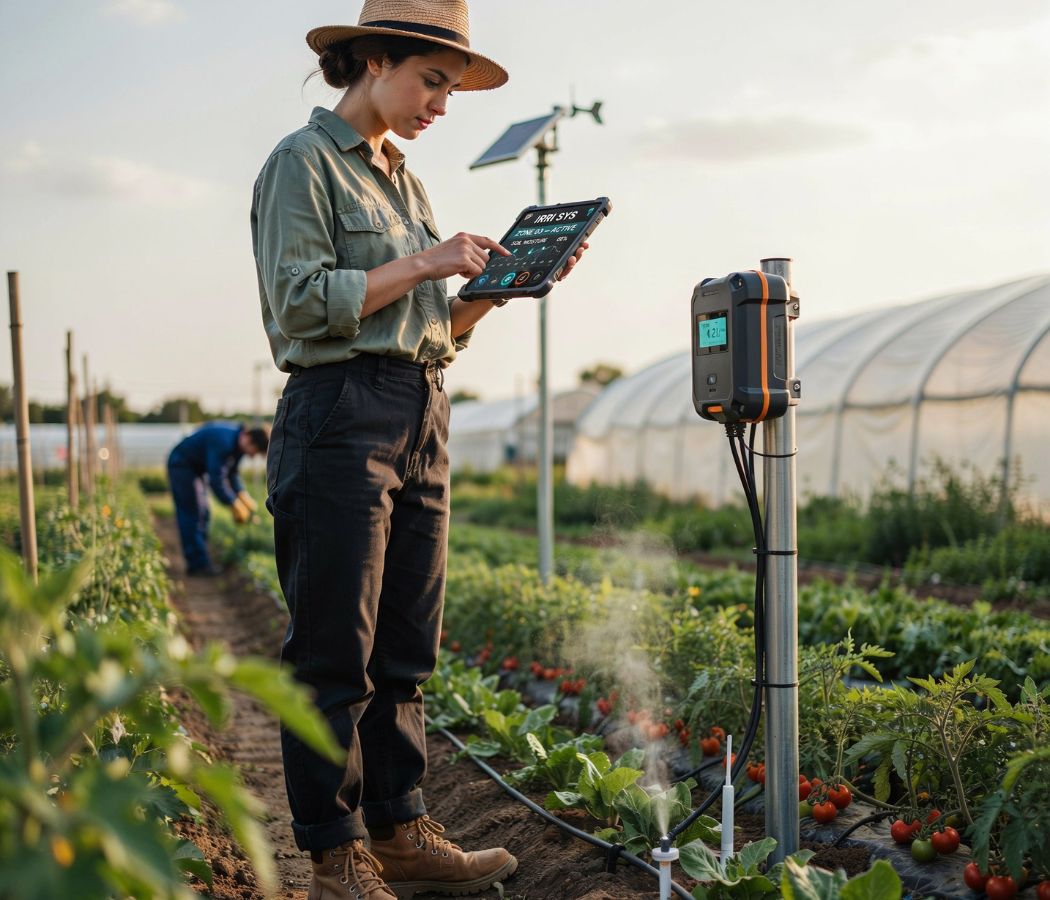
Think of it like Bluetooth for water. Traditional irrigation is a one-way street: you set a clock, water turns on, you hope for the best. IRRISYS (Intelligent Remote Regulated Irrigation System) is a closed-loop, real-time feedback ecosystem. It combines three distinct layers:
-
Sensing Layer: Soil moisture tensiometers, weather telemetry, and even plant-specific evapotranspiration (ET) sensors.
-
Decision Layer: On-device AI that weighs root depth, soil porosity, and 48-hour weather forecasts.
-
Action Layer: Precision valves that adjust flow rate per second, not per hour.
Most people confuse IRRISYS with a soil moisture probe you stick in the ground. That’s like saying a smartphone is a calculator. The magic isn’t the sensor; it’s the decision engine that learns how your specific soil dries.
A Quick Origin Story
The tech was first prototyped by Dutch greenhouse growers who were tired of “slice-dice” statistics (watering based on average evaporation over a week). By 2023, the first open-source IRRISYS controllers hit the market. By 2026, it’s becoming the default architecture for high-value crops and luxury residential landscapes.
The “Why Now?” Factor: Three Trends Colliding
Why is IRRISYS exploding in 2026? Three silent crises.
First: The Salt-Spike Phenomenon. In the American Southwest and Southern Europe, groundwater tables are dropping. Lower water means higher mineral concentration. Traditional timers keep adding water that is itself toxic because of salinity. IRRISYS flushes strategically, not chronically.
Second: The Labor Cliff. A professional irrigator is retiring faster than we can train new ones. Smart systems must replace guesswork. IRRISYS doesn’t need a technician to adjust heads—it does it hydraulically.
Third: Regulatory Pressure. As of January 2026, seven U.S. states now require “predictive scheduling” on any new irrigation install over 1 acre. The old “water twice a week for 20 minutes” rule is legally obsolete. IRRISYS is the only compliance path that doesn’t drive you crazy.
How IRRISYS Actually Works (The 20-Second Engineering Lesson)
Let me simplify a complex hydraulic model into a single image.
Imagine your soil isn’t dirt. It’s a sponge.
-
Old method (Timer): You pour a bucket of water on the sponge every Monday, Wednesday, and Friday. You don’t check if the sponge is still wet from Tuesday. You just pour.
-
IRRISYS method: You have a hand on the sponge. The moment it feels 70% dry, you add exactly one cup of water—spread evenly over the next 4 minutes—so there’s zero runoff.
Concretely, an IRRISYS valve opens and closes dozens of times per hour. It pulses. This “pulse irrigation” allows water to percolate vertically rather than pooling on the surface or running sideways.
Critical distinction: Most systems measure volumetric water content (how much water is present). IRRISYS measures matric potential (how hard the plant has to suck to get that water). A plant can be surrounded by water but starve if the water is held too tightly by clay particles. IRRISYS knows the difference.
7 Actionable Ways to Master IRRISYS (From Novice to Pro)
Whether you’re retrofitting an old system or building new, here’s your roadmap.
1. Start with a Soil Autopsy (Not a Sensor)
The #1 IRRISYS failure is installing $800 sensors into $2 soil. Sensors are only as smart as the medium they sit in.
-
Action: Dig three test holes. Feel the texture. Sandy soil needs pulse cycles every 20 minutes. Clay needs pulse cycles every 90 minutes.
-
Pro tip: Layer your sensors at 4-inch, 8-inch, and 12-inch depths. The 12-inch sensor tells you when deep percolation (wasting water below roots) is happening. Most people only measure the topsoil. That’s a rookie mistake.
2. Calibrate to a “Stress Test” Day
Don’t calibrate IRRISYS in May when it’s mild. Calibrate in August during a heat spike.
-
Action: Manually turn off the system until you see the first 5% of plants start to wilt. Record the soil tension value at that moment. Set that as your “water trigger.”
-
Why this works: You’re finding the absolute drought threshold. Then you water just before that threshold. This builds deep roots and eliminates overwatering.
3. Use the “Rain Delay Multiplier”
IRRISYS systems automatically skip rain, but the smartest users apply a multiplier. After a 0.5-inch rain, the topsoil is wet, but six inches down might still be dry.
-
Action: Set your post-rain delay to 60% of normal. That is, if rain gave you 0.5 inches, don’t skip two days; skip 1.2 days. Then resume at 40% normal runtime.
-
Result: You maintain root moisture without rotting the crown of the plant.
4. Zone by Hydraulic Demand, Not Plant Type
Standard advice says “group plants with similar water needs.” IRRISYS allows a better way: group by flow rate.
-
Scenario: Drip emitters (low flow) and spray heads (high flow) on the same zone create pressure oscillations that confuse the IRRISYS algorithm.
-
Fix: Dedicate one zone to emitters only, another to sprays. The algorithm can then learn the exact pressure decay curve for each type.
5. Enable “Deficit Irrigation” for Fruit & Wine Grapes
Here’s where IRRISYS shines beyond lawn care. For fruit trees and wine grapes, stress increases sugar content.
-
Action: Set a second threshold (e.g., “moderate stress” at -85 kPa). Allow the system to let the soil reach this level before flowering. Then drop to -50 kPa during fruit set.
-
Outcome: Higher brix (sugar) levels and more anthocyanins (color/flavor compounds). Wine growers using IRRISYS report a 15-22% increase in fruit quality scores.
6. Build a Virtual Rain Gauge Network
A single weather station is fine. Five is prophetic.
-
Action: If your IRRISYS controller supports it (most pro models do by 2026), pull precipitation data from three nearby personal weather stations (PWS) via APIs like WeatherFlow or OpenWeather.
-
Algorithm: Average the three, but discard the highest outlier (usually a faulty sensor). This gives you hyperlocal accuracy within 0.02 inches.
7. Schedule a Monthly “Air Shot”
This is my secret trick that no manual mentions. Every 30 days, run a 2-minute cycle with no water (open the valve manually when the pump is off).
-
Why? IRRISYS solenoid valves use rubber diaphragms. If they sit wet for months, they develop biofilm that changes the opening/closing speed. The air shot dries the seal and resets the mechanical hysteresis.
-
Warning: Only do this on systems with a pressure relief valve.
Common Mistakes That Wreck IRRISYS Performance
Even pros mess these up. Don’t be that person.
| Mistake | Why It Fails | The Solution |
|---|---|---|
| Placing sensors under drip line | Emitters create a “cone” of wetness. Sensors miss lateral dry spots. | Place sensors 4-6 inches away from the emitter, not under it. |
| Ignoring the “washout” value | After a deep soak, salts and fine silt migrate down. The sensor reads “wet” but the root zone is salty. | Run a 15% “flush” cycle every 7th cycle to push salts below root zone. |
| Using WiFi only (no cellular backup) | Your router dies, or power flickers. IRRISYS loses its mind and defaults to “off.” | Spend $120 on a 4G backup dongle. It pays for itself the first thunderstorm. |
| Setting the dry threshold too low | You panic at -30 kPa (slightly moist) and water. Plants never develop deep roots. | Let annuals hit -60 kPa. Let perennials/trees hit -100 kPa before watering. |
Balanced Analysis: The Pros, Cons, and Hidden Trade-Offs
Let’s be real. IRRISYS isn’t magic. It’s a tool with sharp edges.
The Pros (Where It Unquestionably Wins)
-
Water savings: 30-55% vs. standard timers. In commercial ag, that’s $200+/acre/year.
-
Labor reduction: No more running valves manually at 6 AM. Exception alerts go to your phone.
-
Fertigation synergy: IRRISYS measures when roots are actively sucking (high transpiration). That’s the exact right moment to inject liquid fertilizer. Efficiency jumps 40%.
-
Regulatory compliance: Already meets California’s AB 2298 and EU’s Water Efficiency Directive 2025.
The Cons (Where You Must Be Skeptical)
-
Initial cost: $1,200–$4,500 per zone for pro-grade hardware (sensors + controllers). Residential DIY kits run $400–$900.
-
Learning curve: The first two months are humbling. Expect false dry alarms as the AI learns your site.
-
Sensor drift: Capacitive sensors lose accuracy after 18-24 months. You must budget for replacement or recalibration.
-
Electricity dependence: A 3-day power outage means no irrigation at all (unlike a manual valve you can open with pliers).
The Hidden Trade-Off (Almost No One Discusses)
IRRISYS changes your relationship with failure.
In a dumb timer, failure is too much water (runoff, rot, high bill). In IRRISYS, failure is too little water (wilt, death, crop loss) if a sensor fails dry. Most users install one sensor per zone. Smart users install redundant sensors (two per zone) and set the algorithm to “water if either sensor is dry” mode. That redundancy costs 30% more but eliminates catastrophic dry-out.
Future Trends: What IRRISYS Looks Like in 2028
The technology is moving fast. Here’s what’s three years out.
1. Solar-Powered Mesh Networks
Current IRRISYS valves need wires or batteries. New prototypes use ultra-low-power LoRaWAN and a thumbnail solar panel. No wires. No battery swaps for 5 years.
2. Weed Detection via Flow Signatures
A weed taking up water has a different “flow micro-vibration” than your crop plant. Algorithms in testing can now identify invasive species by how they suck water and skip irrigating that square foot. No herbicides needed.
3. Carbon Credit Integration
Overwatering releases nitrous oxide (a potent greenhouse gas) from anaerobic soil. IRRISYS’s precise aeration cycles reduce N₂O by up to 60%. By late 2027, you may be able to sell those reductions on carbon markets. A farm with 500 acres could net an extra $8,000–$12,000/year.
4. Predictive Pathogen Modeling
Fungal diseases like Phytophthora thrive on leaf wetness duration. IRRISYS will soon pull your local dew point + canopy temperature and automatically shift watering to morning only when the risk score exceeds 7/10. It’s like a flu shot for your plants.
Practical Next Steps (For Today)
You don’t need a $10,000 system to start.
-
If you’re a homeowner: Buy a single IRRISYS-compatible soil sensor (e.g., Ecowitt WH51 or Irrometer Watermark) and one DC latching solenoid. Hook it to an ESP32 or OpenSprinkler. You’ll spend under $150 to automate one zone. Learn the logic before scaling.
-
If you’re a landscaper: Stop selling “smart controllers.” Sell “site-specific IRRISYS audits.” Charge $350 to map soil types, install 3 pilot sensors, and generate a pulse-schedule report. It’s a high-margin service.
-
If you’re a farmer: Retrofit your most expensive crop first (e.g., berries, nuts, wine grapes). Run a side-by-side comparison with your traditional block for one season. The data will sell itself to your banker.
The Bottom Line (Key Takeaways)
IRRISYS isn’t about technology. It’s about humility.
For 6,000 years, we’ve guessed how much water plants need. We poured water on a sponge and hoped. Now, the sponge can talk. IRRISYS listens to the soil, the plant’s stress, and the sky’s intent—then moves one milliliter at a time.
You don’t have to master every feature on Day 1. Start with one sensor. One zone. One month of letting the algorithm fail (and then learn). By autumn, you’ll wonder how you ever watered blind.