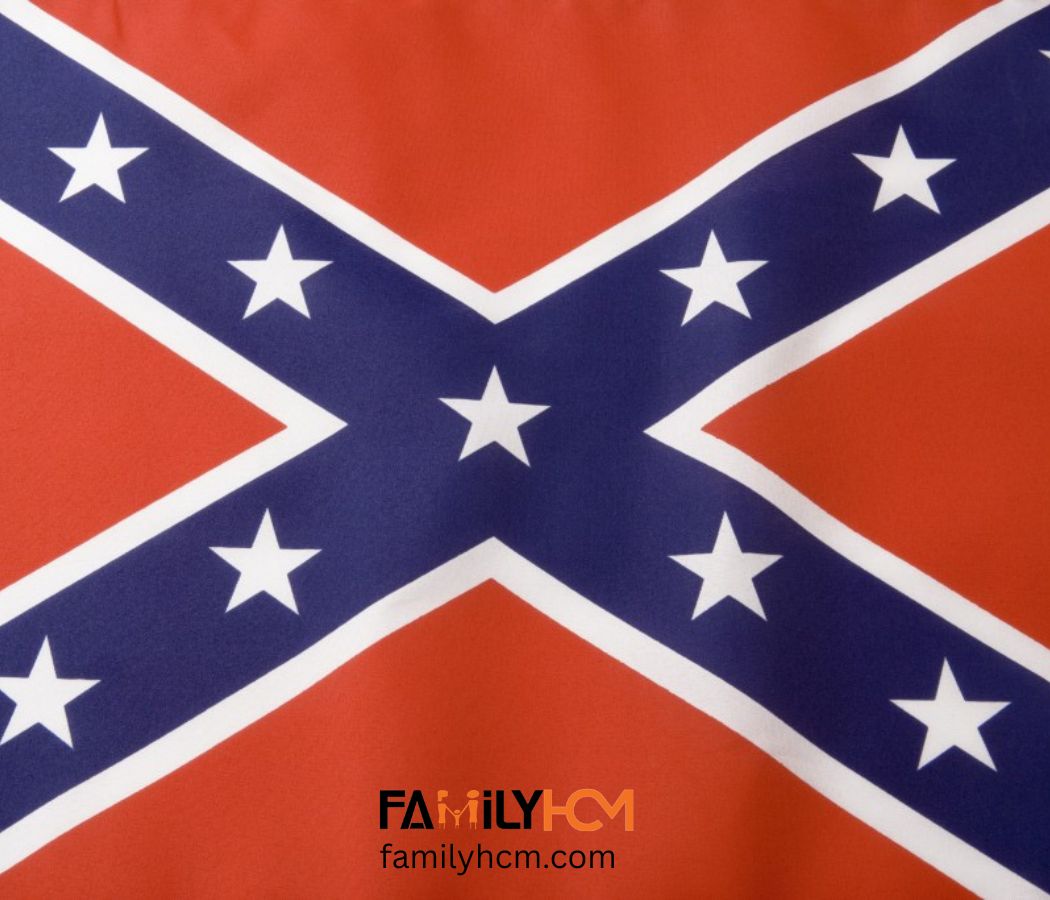
Few symbols in American history evoke as much passion, pain, and polarization as the Confederate flag. To some, it represents Southern heritage, ancestral pride, and the fight for states’ rights. To others, it is an unmistakable emblem of white supremacy, treason, and the brutal legacy of slavery.
But how did one piece of cloth come to hold such contradictory meanings? Understanding the true history of the Confederate flag requires separating 19th-century fact from 20th-century fiction.
The Origins: Not the “National” Flag
First, a critical clarification: The familiar red banner with a blue “X” scattered with white stars is not actually the official national flag of the Confederate States of America (CSA).
-
The First National Flag (1861-1863): Nicknamed the “Stars and Bars,” it featured three stripes (red, white, red) and a blue canton with white stars. It was abandoned because it too closely resembled the U.S. flag on smoky battlefields.
-
The Second National Flag (1863-1865): Known as the “Stainless Banner,” it was mostly white with the Southern Cross (our modern symbol) in the upper corner. Soldiers complained it looked like a flag of surrender.
-
The Third National Flag (1865): Added a red vertical stripe to the “Stainless Banner” to prevent it from being mistaken for a truce flag.
The flag we recognize today is the “Southern Cross” battle flag. It was designed by General P.G.T. Beauregard for General Robert E. Lee’s Army of Northern Virginia. It was never the official flag of the CSA—it was a military tool for unit identification.
The Civil War Context: What Was the Confederacy Fighting For?
To understand the flag, you must understand the government it represented. In their declarations of secession, multiple Confederate states explicitly stated the cause.
While many common soldiers fought for loyalty to their state or home, the Confederate government’s primary objective was the preservation and expansion of chattel slavery. This historical fact is not opinion; it is recorded in the official documents of the period.
The Lost Cause & The Flag’s Resurgence (1890s-1950s)
After the Confederacy’s defeat in 1865, the battle flag largely disappeared. It was a relic of a failed rebellion. That changed during the Jim Crow era.
White Southerners, seeking to reassert racial hierarchy and resist Reconstruction, invented the “Lost Cause” mythology. This revisionist history claimed the Civil War was not about slavery, but about “states’ rights” and “honorable Southern tradition.”
-
The United Daughters of the Confederacy (UDC) placed monuments and battle flags across the South in the early 1900s.
-
These efforts were explicitly designed to glorify the Confederacy and intimidate newly freed Black citizens.
During this period, the battle flag was transformed from a military banner into a political symbol of white resistance.
The Modern Flashpoint: The Civil Rights Movement (1950s-1960s)
The Confederate flag exploded back into the national consciousness during the fight against segregation.
-
1956: Georgia incorporated the battle flag into its state flag as a direct protest against the Supreme Court’s Brown v. Board of Education ruling.
-
1962: South Carolina raised the Confederate battle flag over its Statehouse dome to mark the Civil War centennial—and kept it there as a gesture of legislative defiance against the civil rights movement.
-
Ku Klux Klan: The Klan and other white supremacist groups adopted the battle flag as their primary symbol during protests and lynchings.
From this point forward, for millions of Americans, the Confederate flag was inseparable from massive resistance to racial equality.
The “Heritage vs. Hate” Debate
Today, the debate over the flag centers on two competing narratives:
The “Heritage” Argument
-
The flag honors ancestors who fought and died for their home states.
-
It represents Southern pride, independence, and a rural way of life.
-
Removing it erases history.
The “Hate” Argument
-
The flag represents a nation founded to preserve slavery.
-
It was revived as a tool of Jim Crow segregation and Klan violence.
-
For Black Americans, the flag signals a threat of violence and second-class citizenship.
Historians generally side with the “hate” argument. Why? Because the “heritage” being honored is a heritage of white supremacy. The Confederate soldier fought to uphold a system where one human could own another. No amount of “states’ rights” rhetoric changes that primary cause.
Public Opinion & Major Turning Points
Public perception of the flag has shifted dramatically in recent years.
-
2015: After a white supremacist murdered nine Black parishioners at Mother Emanuel AME Church in Charleston, SC, photos emerged of the killer posing with the Confederate flag. In response, South Carolina removed the flag from its Statehouse grounds after 54 years.
-
2020: Following the murder of George Floyd and nationwide racial justice protests, NASCAR banned the Confederate flag from all events and properties. The US Marine Corps also removed the flag from its installations.
-
Retailers: Walmart, Amazon, eBay, and Etsy have all banned the sale of Confederate flag merchandise.
According to a 2021 YouGov poll, while 55% of white Southerners view the flag as a symbol of pride, 72% of Black Americans view it as a symbol of hate.
The Flag Today: A Symbol of Extremism
Modern usage of the Confederate flag has largely moved outside the mainstream. It is now commonly seen:
-
At white nationalist rallies (Charlottesville, 2017).
-
On the license plates of neo-Nazi groups.
-
In the insurrection at the US Capitol on January 6, 2021 (where a Confederate flag was paraded through the halls for the first time in history).
The Southern Poverty Law Center (SPLC) and Anti-Defamation League (ADL) both classify the Confederate battle flag as a hate symbol, though they note it can have non-hateful uses in historical reenactments or museums.
Conclusion: Can a Symbol Change?
Symbols are not static. The swastika was once a symbol of good luck; today, it represents genocide. The Confederate flag, whatever its original military purpose, has been transformed by history.
For 78 years (1865-1943), the flag was mostly forgotten. For the last 80 years, it has been a deliberate tool of racial intimidation and segregationist politics. While individuals may genuinely believe they are honoring their great-great-grandfather, the flag they are waving did not fly over his farmhouse—it flew over armies fighting for slavery, and later, over the Capitol buildings fighting against civil rights.
To display the Confederate flag today is to accept that history. As the debate continues, one fact remains undeniable: For nearly half the country, it will never be a symbol of unity. It is, and will likely remain, the most divisive banner in American history.
Frequently Asked Questions (FAQ)
Q: Is the Confederate flag illegal?
A: No. In the United States, it is protected speech under the First Amendment. Some private companies and organizations have banned it, but government entities cannot (with limited exceptions).
Q: What do the stars on the flag mean?
A: The 13 stars represent the 11 states that formally seceded (South Carolina, Mississippi, Florida, Alabama, Georgia, Louisiana, Texas, Virginia, Arkansas, North Carolina, Tennessee) plus two border states (Kentucky and Missouri) that had competing pro-Confederate governments.
Q: Was the Confederate flag the official US flag?
A: No. The United States flag is the Stars and Stripes. The Confederate flag represented a separate, unrecognized nation.
Q: Did the Nazis use the Confederate flag?
A: Not historically. However, modern American neo-Nazis and white supremacists have adopted it as a symbol of the “white race.”