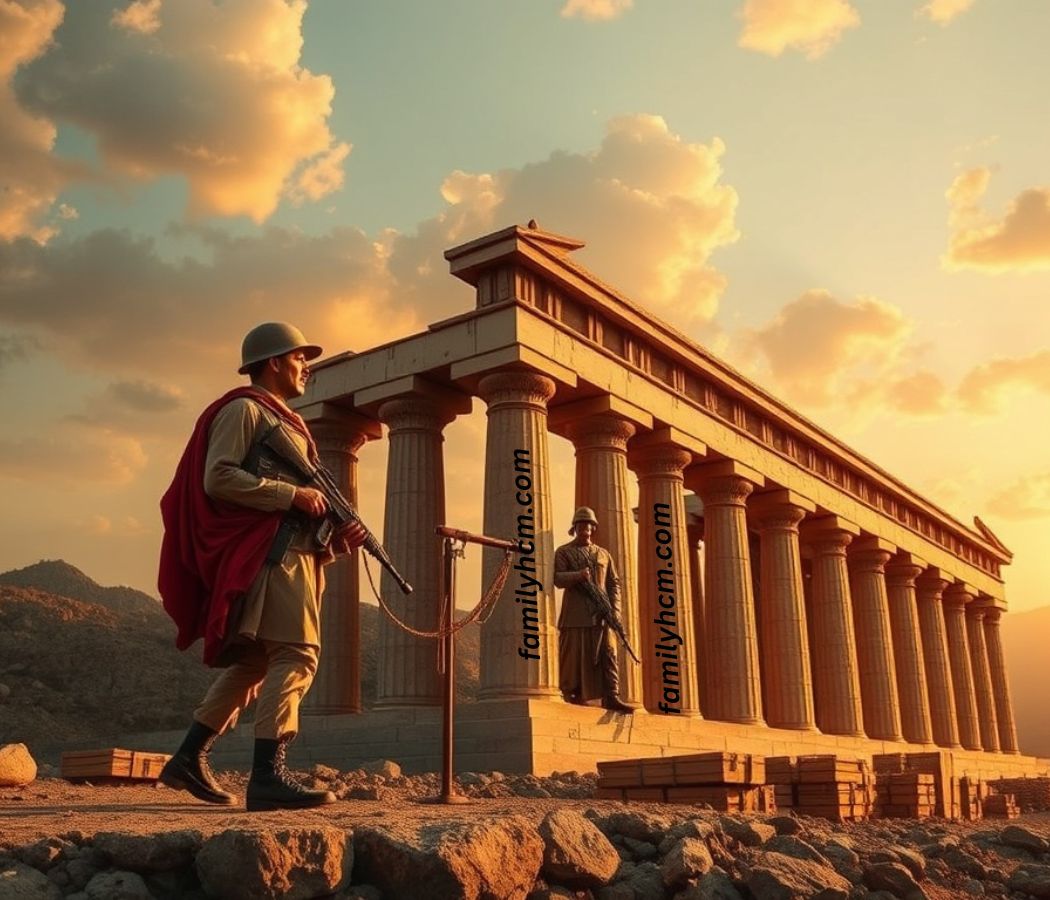
When you wake up in the morning and enjoy a cup of coffee from Colombia while checking your phone—assembled in China with a screen made in South Korea—have you ever wondered how these products travel thousands of miles to arrive precisely at your doorstep? Behind this everyday miracle lies an ancient and mysterious profession and the discipline it represents: Logistics. Today, we are exploring the keyword “logisths“—a term with deep historical roots. It refers both to the military financial officers of ancient Greece and forms the prototype of the modern “logistician.” This article will take you on a journey through time to explore the fascinating evolution of logistics from ancient battlefields to modern commerce.
Table of Contents
ToggleThe Dual Origins in Ancient Greece: Accounting and Supply
The English word “Logistics” is derived from the Greek word “λογιστικός” (Logistikos), which fundamentally means “skilled in calculating” or “the science of reckoning.” However, in the reality of the ancient Greek city-states, this term evolved into two distinct yet related professional paths.
1. The Auditors of Athens: The Logistai
In 4th century BC Athens, there existed a public office known as the “Logistai.” These individuals were not responsible for managing物资 transportation; instead, they served as auditors who scrutinized the accounts of public officials. Selected by lot, their duty was to rigorously examine the financial records of magistrates at the end of their terms. This system of overseeing public funds and management laid an early foundation for future financial administration.
2. The Calculators on the Battlefield: The Logistikos
Simultaneously, on the battlefields of ancient Greece, another type of expert emerged: the military logistics officer. In ancient Greek, logistikos referred to officers specifically tasked with calculating troop requirements and organizing the supply of provisions. Whether for a land march or a naval expedition, commanders had to precisely calculate soldiers’ rations, weapon reserves, and the capacity of transport (such as wagons and warships). For instance, Greek generals understood that using wagons slowed down an army’s march, while relying on sea transport limited the number of cavalry they could bring. Behind these strategic decisions was rigorous “calculation.” In essence, the Logistikos was the “operator” who ensured victory through data-driven resource management.
The Foundation of the Roman Empire: Logistics Determines Victory and Defeat
If the Greeks invented the concept of logistics, the Romans perfected it into an art. The Greek historian Polybius noted that the Romans’ key to conquering the world lay in their “inexhaustible supplies of provisions and men.”
The Roman Empire built an exceptional logistics system. They constructed the famous Roman roads (the saying “all roads lead to Rome” was initially about military movement) and established standardized warehouse systems. The great military commander Julius Caesar always considered supply as a primary factor when formulating his strategies. The Romans firmly believed that strategy and tactics were deeply rooted in logistical capability. Furthermore, in the later Roman Empire, officials known as “logistae” were sent to oversee the finances of provincial cities, continuing the Greek tradition of emphasizing “calculation” and “administration.”
Slumber in the Middle Ages and the Awakening of the Industrial Revolution
With the fall of the Western Roman Empire, Europe entered the Middle Ages, and large-scale, systematic logistical thinking seemed to fall into a deep slumber. However, the basic activities of logistics persisted: the supply roads and the castles and waystations built along trade routes became critical nodes for storing and distributing goods.
The true revival of logistics began with the Industrial Revolution. The advent of railways, steamships, and mass production created new, unprecedented challenges and opportunities for moving goods, setting the stage for the modern era. It was from these ancient roots of “logisths”—the calculators, auditors, and supply officers—that today’s complex global supply chains and the vital profession of the logistician were born.
Conclusion: The Eternal Equation of Civilization
The journey of the “logisths” from the auditor’s chambers of ancient Athens to the algorithmic hubs of modern logistics parks is far more than a simple etymology lesson. It is a profound narrative about the very foundation of civilization.
What began as a simple act of counting—grain for soldiers, funds for temples—has evolved into the complex, invisible nervous system of our globalized world. The core principle, however, has remained remarkably consistent for three thousand years: the reconciliation of supply with demand, of resources with needs.
The ancient logisths, whether a Greek logistikos calculating an army’s rations or a Roman logista auditing a province’s finances, understood a fundamental truth that every modern supply chain manager knows today: strategy is impotent without logistics. A grand vision for a campaign or a business cannot be executed if the means to support it are not meticulously planned and managed.
We live in an era of unprecedented logistical complexity, where goods circle the globe in a choreographed dance of container ships, drones, and just-in-time delivery. The tools have changed—from papyrus scrolls to artificial intelligence—but the mission remains the same. The modern logistician is the direct descendant of the ancient “logisths,” tasked with solving the eternal equation of civilization: getting the right thing, to the right place, at the right time.
As we look to the future—to supply chains that must be not only efficient but also resilient, sustainable, and ethical—the ancient wisdom embedded in the word “logisths” serves as a powerful reminder. Progress is not just about invention; it is about the invisible, intelligent, and tireless effort of calculation and coordination that makes it all possible. The history of the “logisths” is, in many ways, the hidden history of how the world works.
Frequently Asked Questions (FAQs)
1. What is the simplest definition of a “logisths”?
In its original ancient Greek context, a “logisths” (λογιστής) was a public official responsible for auditing and counting. Today, the closest modern equivalent is a combination of a logistician and a financial controller—someone who manages and accounts for resources.
2. Is there a difference between “logisths,” “logistics,” and “logistician”?
Yes, they represent the evolution of the word:
-
Logisths (Ancient Greek): The person—the auditor or military supply officer.
-
Logistics (Modern English): The discipline or process—the science of planning and executing the movement and support of operations.
-
Logistician (Modern English): The professional who practices logistics.
3. How did ancient armies, like the Romans, manage logistics without technology?
They relied on meticulous planning, standardization, and infrastructure. Roman armies used a system of:
-
Standardized units: Consistent soldier equipment and rations made calculation easier.
-
Road networks: Allowed for rapid, predictable movement of supplies.
-
Fortified granaries: Stored grain at strategic points along borders and supply routes.
-
Detailed manuals: Commanders used written handbooks to calculate required supplies based on troop numbers and march distances.
4. Did other ancient civilizations have “logisths”?
While they may not have used the specific Greek term, every major civilization had analogous roles. For example, ancient Egypt had scribes who meticulously recorded and managed the grain stored in state warehouses, which was crucial for feeding the population and the army. The core function of resource management and accounting is universal.
5. Why did logistics become important again after the Middle Ages?
The large, standing armies of early modern Europe (like those of Louis XIV or Frederick the Great) created demand on a scale not seen since the Roman Empire. Feeding, arming, and moving tens of thousands of soldiers required a revival of systematic supply thinking. This was later supercharged by the Industrial Revolution, which created mass-produced goods and new transportation technologies (railroads, steamships), making logistics a critical factor for both military and commercial success.
6. What does a modern “logisths” (logistician) do today?
Modern logisticians are the architects of the supply chain. Their work includes:
-
Procurement: Sourcing raw materials.
-
Inventory Management: Deciding how much stock to keep.
-
Transportation: Planning the most efficient routes and modes (truck, ship, rail, air).
-
Warehousing: Designing and managing storage facilities.
-
Demand Forecasting: Predicting future sales to ensure products are available.
-
Data Analysis: Using software to track goods, optimize flows, and cut costs.
7. What is the “Bullwhip Effect” in modern logistics?
This is a common phenomenon where small fluctuations in consumer demand at the retail level cause increasingly larger fluctuations in demand at the wholesale, distributor, and manufacturer levels. It’s a classic example of what happens when the “calculation” aspect of logistics (the ancient logistikos skill) breaks down or is poorly coordinated across a supply chain.
8. How can I become a logistician?
While a specific “logisths” degree doesn’t exist, you can enter the field through:
-
Education: Degrees in Supply Chain Management, Logistics, Business Administration, or Industrial Engineering.
-
Certifications: Professional certifications like APICS CPIM (Certified in Production and Inventory Management) or CSCP (Certified Supply Chain Professional).
-
Skills: Developing strong analytical, problem-solving, and organizational skills is crucial. In the spirit of the ancient logisths, you must be “skilled in calculating.”
9. How does logistics affect my daily life?
Logistics is the invisible force that makes modern life convenient. Every time you buy a product online and it arrives in two days, find fresh fruit from another hemisphere in your grocery store, or fill up your car with gas, you are witnessing the successful work of thousands of logisticians. Without them, shelves would be empty, and global trade would grind to a halt.
10. What is the future of the “logisths” profession?
The future of logistics is being shaped by technology and global challenges. Key trends include:
-
Artificial Intelligence (AI): For predictive analytics, route optimization, and demand forecasting.
-
Automation and Robotics: In warehouses for packing and sorting.
-
Blockchain: For creating transparent and secure supply chain records.
-
Sustainability: A major focus on “green logistics” to reduce carbon emissions.
-
Resilience: Building supply chains that can withstand shocks like pandemics, geopolitical events, and natural disasters.